
When I teach about the history of the United States (or Canada, but today I’ll be focusing on the U.S.), I begin with the premise that you can’t teach the development of these nations without engaging with Indigenous histories. Indigenous histories are not an “add on” or accessory to American history—they are integral to understanding American history. You can see this relationship in any era of U.S. history, but I think it’s especially clear in the decades after the Revolutionary War. Events in this era, like the signing of the Treaty of Greenville in 1795, show how the growth of the United States was dependent on the nation gaining control of Indigenous lands. The United States’ efforts to acquire those territories intertwined American and Indigenous politics.
The Treaty of Greenville stemmed from the Northwest Indian War. The roots of the Northwest Indian War trace back to the end of the Revolutionary War when Congress authorized a commission to inform the Indigenous peoples of the Ohio Valley of the United States intention to establish a boundary between American and Native territory running from the mouth of the Great Miami River to Lake Erie. This proposed border gave the United States control of most of present-day Ohio.
Indigenous leaders objected to the boundary and insisted on the Ohio River as the boundary. In response, the Americans informed them of their intent to claim the territory by conquest. While some Indigenous leaders subsequently agreed to the boundary by signing the Treaty of Fort McIntosh in 1785, many Indigenous people viewed the treaty as illegitimate.
The United States needed to establish this boundary because the young nation was deeply in debt following the Revolutionary War. Since the federal government lacked authority to tax under the Articles of Confederation, officials planned to raise funds to support the nation through the sale of Indigenous lands to American settlers in areas like the Ohio Valley. In other words, the sale of Indigenous lands would not only support the nation’s growth, it would finance it.
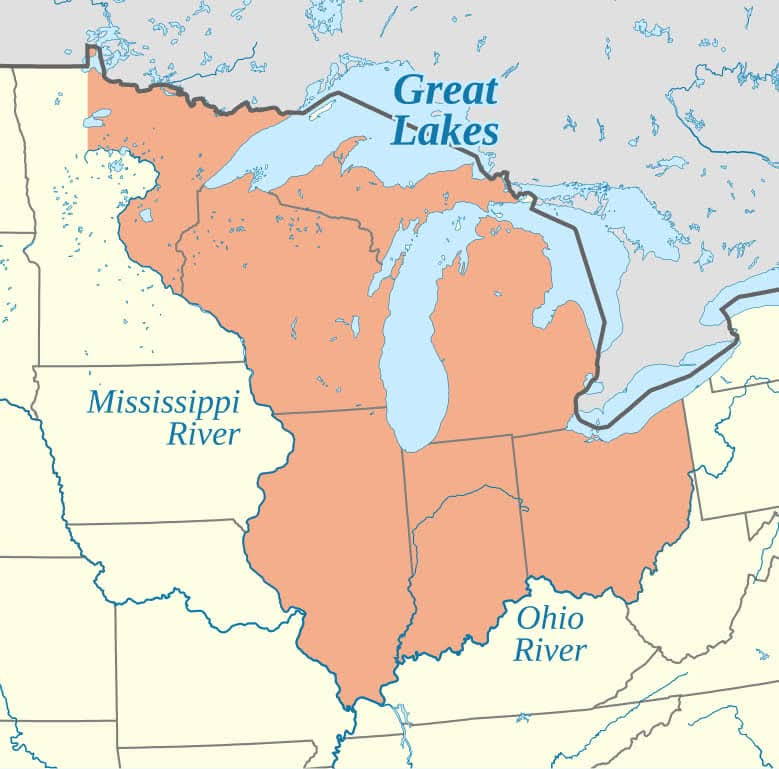
Map of the Northwest Territory when it was created in 1787. The southern part of this area became the heart of the Northwest Indian Wars. Map from Wikimedia Commons.
In response to the Treaty of McIntosh, Indigenous peoples organized a multiethnic confederation of allies, the United Indian Nations (sometimes known as the Northwest Confederacy). Continuing tensions over the proposed boundary between the United States and the United Indian Nations led to the outbreak of the Northwest Indian War, a series of armed conflicts between the United Indian Nations and American forces in the late 1780s and early 1790s.
The United Indian Nations were a diverse, multinational confederacy, whose members spanned the newly created border between American territory and British Canada in the Great Lakes. Influential Indigenous leaders included, include Little Turtle Miami (Myaamia, sometimes known as Miami), Blue Jacket (Shawnee), Buckongahelas (Lenape, sometime known as Delaware), and Thayendanegea, also known as Joseph Brant (Mohawk). Similar to how American founding fathers had differing opinions but united around key beliefs, leaders of the United Indian Nations also had varying opinions on the best tactics to achieve their goals.


Initially, the United Indian Nations successfully defended the Ohio Valley. They defeated General Josiah Harmar’s campaign in 1790, and Arthur St. Clair’s campaign in 1791. Both Harmar and St. Clair commanded forces of over 1,400 men.
In response to these successes, the Americans sent General Anthony Wayne to the region. In August 1794, Wayne led his men to a victory at the Battle of Fallen Timbers at Maumee, Ohio (located just south of present-day Toledo). This was the most decisive American win during the Northwest Indian Wars. Wayne’s army killed approximately forty to sixty warriors, but the worst destruction came afterward. Echoing American actions during the Sullivan Campaign in the Revolutionary War, the army burned cabins and cornfields, uprooted gardens, and despoiled graves on a fifty-mile stretch of the Maumee River.
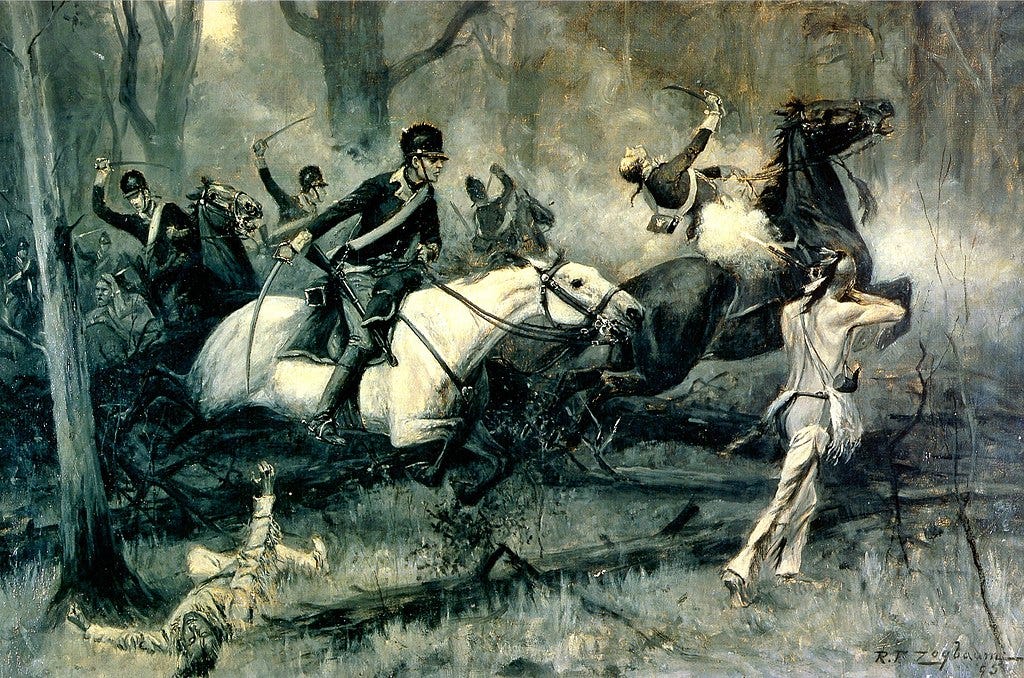
Painting titled "Charge of the Dragoons at Fallen Timbers” by R. T. Zogbaum for Harper's Magazine in 1895. Image available on Wikimedia Commons.
The British, who previously assisted the United Indian Nations as a strategy to weaken the young American nation, were reluctant to assist or support since officials feared provoking a war with the American military while they were involved in a conflict with revolutionary France. Throughout the late eighteenth and early nineteenth centuries, Britain proved an unreliable ally for Indigenous confederacies and nations resisting American expansion.
The year following the Battle of Fallen Timbers, Wayne negotiated the Treaty of Greenville. With towns in ruins and British assistance absent, many leaders signed the treaty, which ceded over two-thirds of southern and eastern Ohio and parts of Michigan, Indiana, and Illinois to the United States. Many of these areas contained existing U.S. forts or had already been ceded to the French or British by Indigenous groups (like Detroit and Mackinac Island). The section of Illinois ceded included "one piece of land six miles square at the mouth of the Chikago river, emptying into the south-west end of Lake Michigan, where a fort formerly stood." Within a decade, Fort Dearborn (near present-day Chicago) was established.
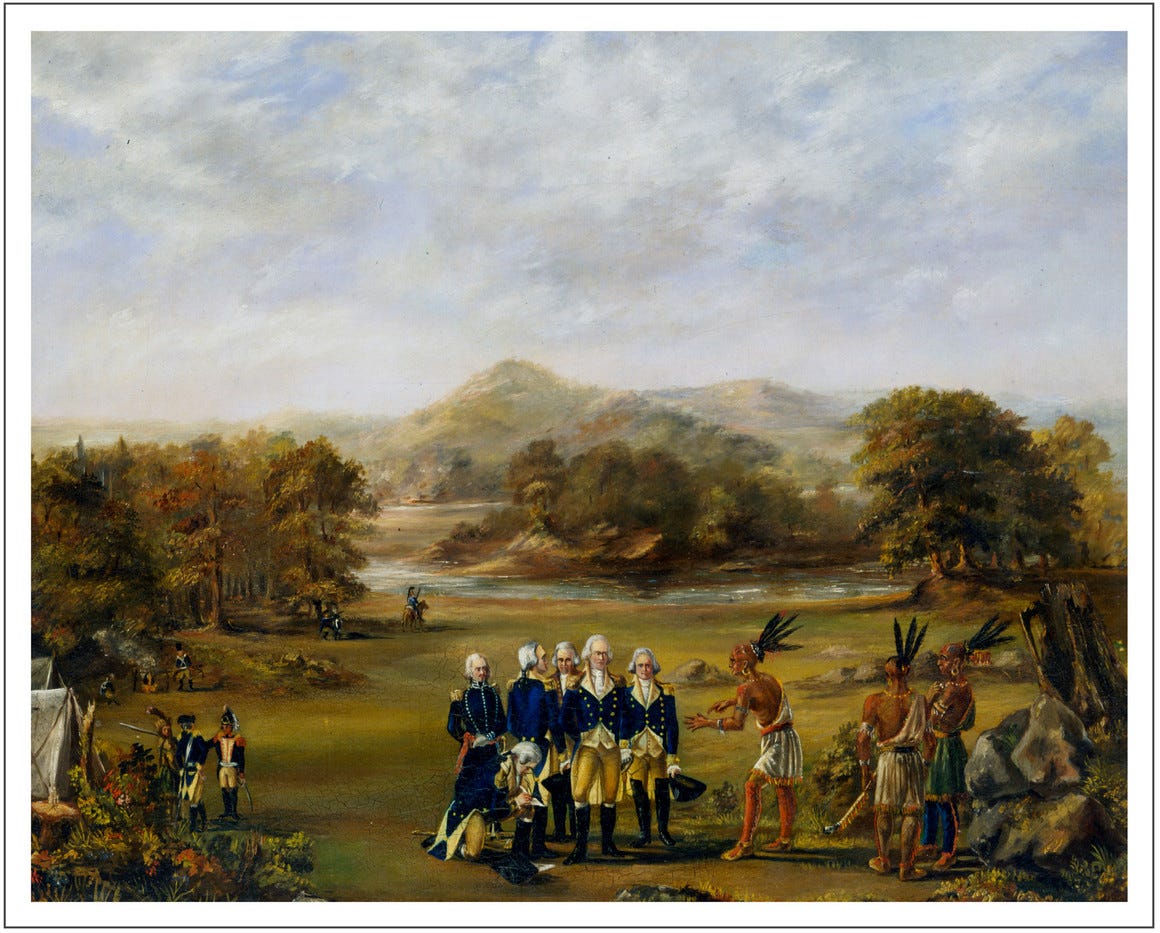
Painting of the Treaty of Greenville from around 1795. The principal figures believed to be represented therein are General Anthony Wayne, the officer, front view, with standing near Little Turtle. William Henry Harrison, stands to the right of General Wayne. Captain William Wells is the officer kneeling and acting as the interpreter and transcribing the Little Turtle’s speech. The original painting is held by the Chicago Historical Society and this image is available on Wikimedia Commons.
On the surface the treaty attempted to create a new western boundary between American and Indigenous lands. In reality, it marked a major land seizure following a long and violent war. American settlers quickly ignored the boundary. In this way, the treaty ushered in further land grabs as American settlers streamed into the Ohio Valley, the majority of the Lake Michigan watershed, and the surrounding regions. In many ways, the Treaty of Greenville laid the foundation for increased American settlement (including cities like Detroit and Chicago), and further land cession treaties in the Great Lakes, like the Treaty of Chicago in 1833, The Treaty of Washington in 1836, and the Treaty of St. Peter's in 1837 (often known as the Pine Treaty).
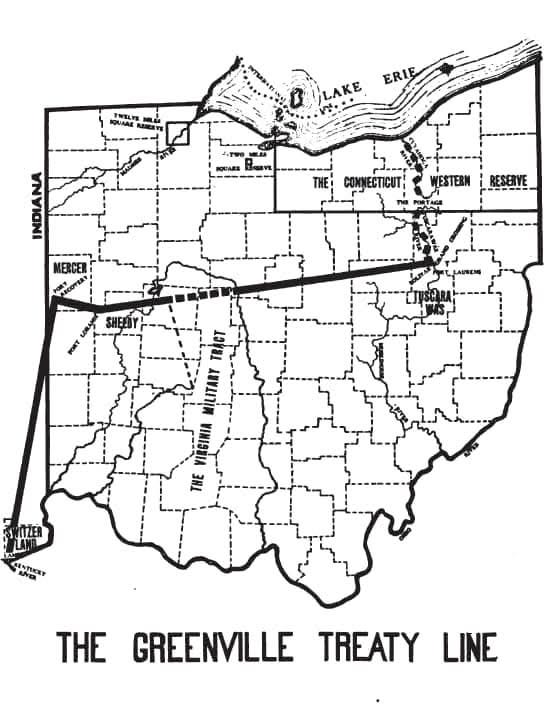
Map showing boundary between Indigenous and American lands in the Ohio Valley by William E Peters, (1918) Ohio Lands and Their Subdivisions, p. 98. Image from Wikimedia Commons.
The Northwest Indian Wars and the Treaty of Greenville illustrate how you cannot tell the story of the growth of the American nation without engaging with Indigenous histories. These histories cannot be separated. To accurately understand how the United States expanded its land base, one must understand Indigenous histories.
This is why I teach Indigenous histories as central to the story of the United States, not as background but as foundational. Understanding how the nation grew through the displacement and resistance of Indigenous peoples forces us to confront the values and narratives that shape our present. History is not disconnected from the present; it informs the present. When history is told in ways that erase the role of Indigenous peoples and nations, we should ask why that narrative is being taught and who is benefitting from it.
If you’re looking for suggestions on how to learn more about the United Indians Nations or the Northwest Indian Wars, I highly recommend Samantha Seeley’s Race, Removal, and the Right to Remain: Migration and the Making of the United States, (Omohundro Institute of Early American History and Culture and the University of North Carolina Press, 2022). Another great source is Richard White’s The Middle Ground: Indians, Empires, and Republics in the Great Lakes Region, 1650-1815,(New York: Cambridge University Press, 1991). This is a dense, but very informative canonical account of the Indigenous histories of the Great Lakes, including a detailed discussion of the American and Indigenous tensions in the Ohio Valley following the American Revolutionary War.
Do you have suggestions about other sources to learn about the United Indian Nations or the Northwest Indian Wars? Or do you have questions about the Treaty of Greenville? Feel free to comment below!