
On August 5, 1826, the Treaty of Fond du Lac was signed between Ojibwe peoples in the Lake Superior watershed and the American government. The treaty negotiations occurred at the western end of Lake Superior, in what is now Duluth, Minnesota. The treaty must be understood in the context of the Treaty of Prairie du Chien, signed the previous year. American desire for control over land (as exemplified by the Treaty of Prairie du Chien) and minerals (as illustrated by the Treaty of Fond du Lac) were the main motivations behind these negotiations.
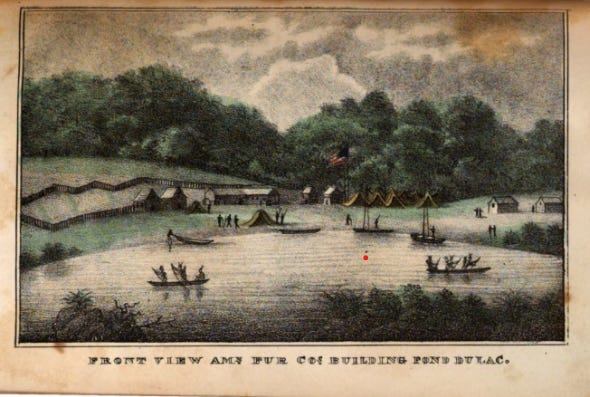
A drawing of the American Fur Company buildings at Fond du Lac as seen the from the river published in Thomas L. McKenney, Sketches of a tour to the Lakes, of the Character and Customs of the Chippewa Indians, and of Incidents Connected with the Treaty of Fond du Lac, 1827.
In 1825, the United States met with Dakota, Menominee, Ho-Chunk, and Ojibwe leaders for a treaty council at Prairie du Chien. This treaty outlined the boundaries between Indigenous nations’ lands. It was the first time such boundaries in this region were mapped—and fixed—on paper. However, only some Ojibwe leaders attended. To confirm those boundaries with broader Ojibwe participation, the United States arranged another treaty with leaders throughout the region.
While the Treaty of Prairie du Chien did not cede or transfer any land to the United States, it laid the foundation for future land cession treaties. Before the federal government could ask tribal nations to cede (sell) land, it needed Indigenous peoples to agree—at least on paper—on who held what territory.
The Treaty of Fond du Lac in 1826 confirmed those boundaries, but it also did not cede land. Instead, it established an exclusive diplomatic relationship between the Ojibwe at the treaty and the United States.
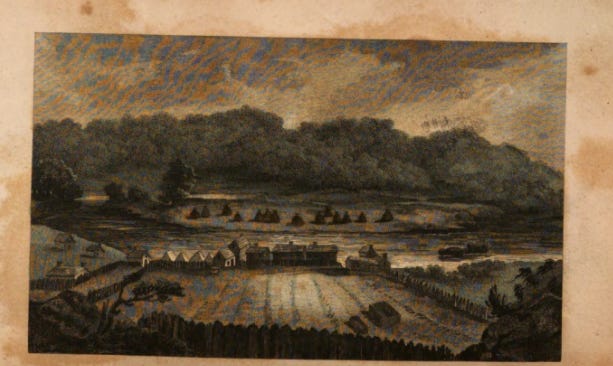
A drawing of the American Fur Company buildings at Fond du Lac as seen from the back published in Thomas L. McKenney, Sketches of a tour to the Lakes, of the Character and Customs of the Chippewa Indians, and of Incidents Connected with the Treaty of Fond du Lac, 1827.
Essentially, the United States sought to end Ojibwe relationships with British traders and officials. Maintaining ties with both the British and Americans had allowed the Ojibwe to negotiate from a position of strength. The Americans aimed to pressure the Ojibwe to deal solely with them. This was a move intended to pave the way for future land sales.
The treaty also granted the United States the right to search for and mine minerals on Ojibwe lands. Americans were fascinated by reports of boulders of pure copper and high-quality iron. However, these rights did not “affect the title of the land, nor the existing jurisdiction over it.” American jurisdiction would come later, through subsequent treaties, and would spark a series of extractive boom-bust industries, including copper and iron mining. But in 1826, the Ojibwe remained the dominant political and demographic power in the Lake Superior region.
At Fond du Lac, Ojibwe people negotiated for government annuities and land allotments for Anishinaabe women who had married Euro-American men, as well as for their mixed-ancestry children. Individual land grants were common in treaties. American officials viewed them as tools to assimilate mixed-descent community members and to privatize parts of Indigenous lands. Ojibwe and other Great Lakes communities saw them as strategies to grow council fire membership by incorporating children of fur trade marriages into kin networks as American pressure intensified.
Ozhaawashkodewekwe, an Ojibwe woman I’ve written about previously, attended the treaty. Born in the Chequamegon Bay area (not far from Fond du Lac), she spent most of her adult life near Bawating (Sault Ste. Marie), at the eastern entrance of Lake Superior. She was the daughter of an influential civil leader, Waubojiig, and married to a successful Irish fur trader, John Johnston. Her daughter, Jane, married Henry Rowe Schoolcraft, an American geologist and geographer who became the Superintendent for Indian Affairs.
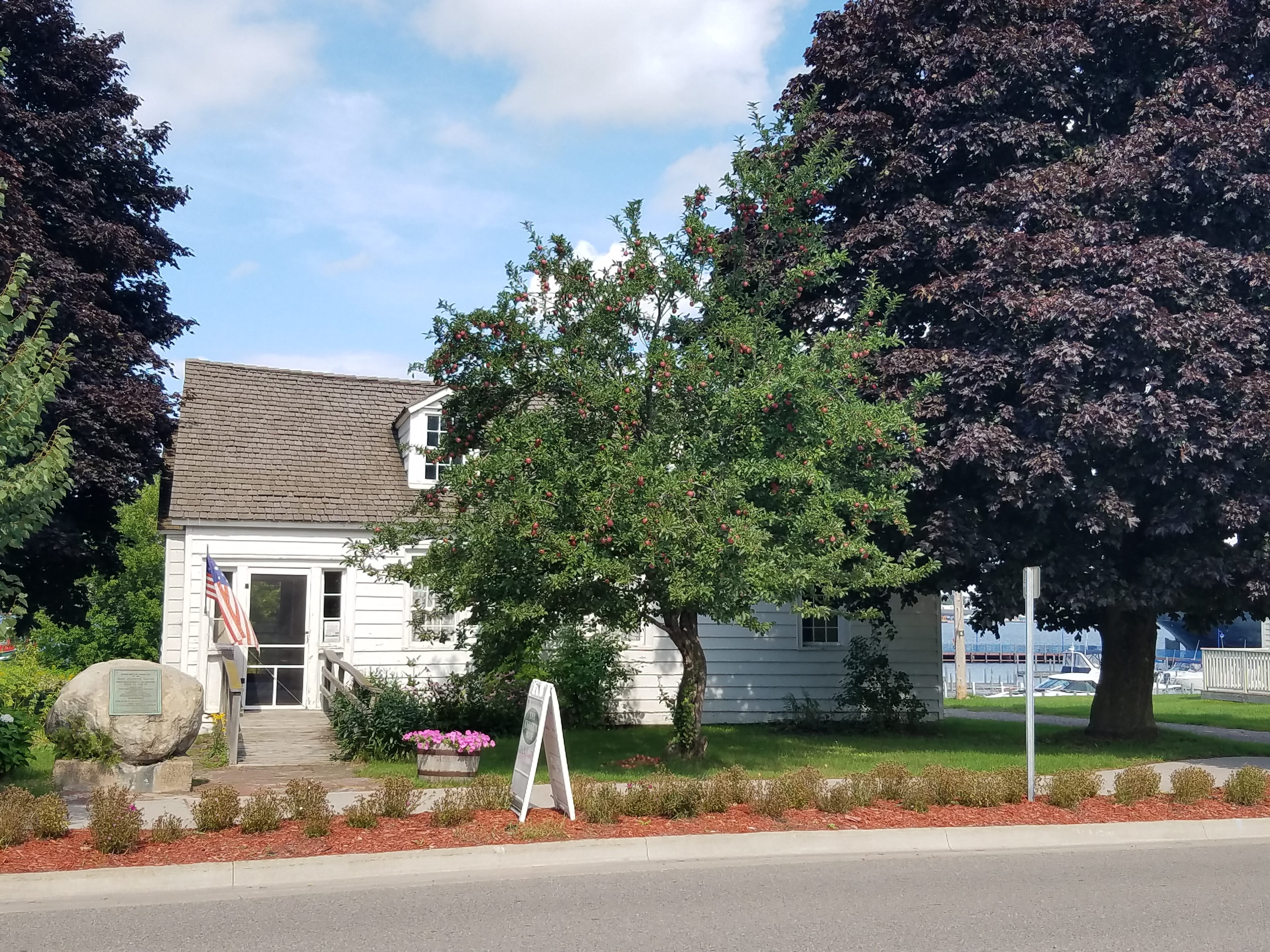
The Johnston family house in Sault Ste. Marie, Michigan. Image from the author’s collection.
At Fond du Lac, Ozhaawashkodewekwe worked to ensure that multiple generations of her family received land grants. Her influence is evident in the treaty’s structure. She is the first name listed and the only person awarded a specific location: her maple grove and sugar campsite on Sugar Island in the St. Mary’s River. She had stewarded this sugar grove since arriving in the eastern Lake Superior region in the late 1700s. She is also the only woman to receive an additional allotment for each grandchild.
Ozhaawashkodewekwe’s influence came in part from her family connections. Her son-in-law, Henry Rowe Schoolcraft, helped negotiate the treaty. Under the land grants, he listed her Ojibwe name (Ozhaawashkodewekwe) instead of her Christian name (Susan Johnston) to conceal the benefits his wife and children received—particularly from Congress and the Senate. This is one example of how Schoolcraft manipulated family ties for personal and political gain.
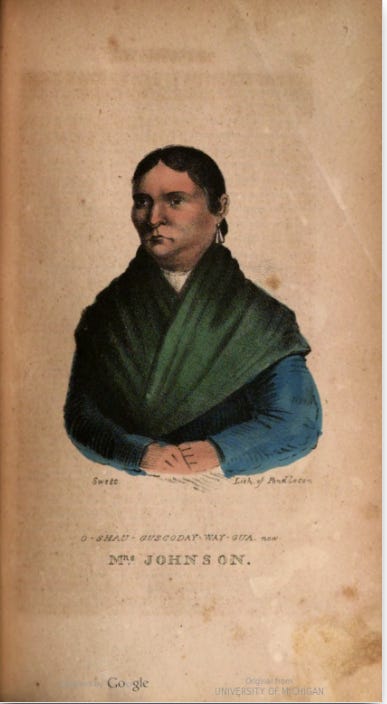
An image of Ozhaawashkodewekwe published in Thomas L. McKenney, Sketches of a tour to the Lakes, of the Character and Customs of the Chippewa Indians, and of Incidents Connected with the Treaty of Fond du Lac, 1827. Image accessible on Hathi Digital Trust.
Was Ozhaawashkodewekwe’s role simply a reflection of the ambitions of the Euro-American men in her family—like Johnston and Schoolcraft? Not surprisingly, the archival record is silent on her motivations. But looking at the broader context shows how reducing her actions to male self-interest erases her larger responsibilities.
Throughout her life, including as a widow, Ozhaawashkodewekwe asserted her Ojibwe identity. She spoke the Ojibwe language, dressed in Anishinaabe styles, followed seasonal rounds, and upheld her clan responsibilities, including stewarding the land granted by her kin networks. All of this occurred as the United States worked to gain access to the region’s valuable minerals and forests.
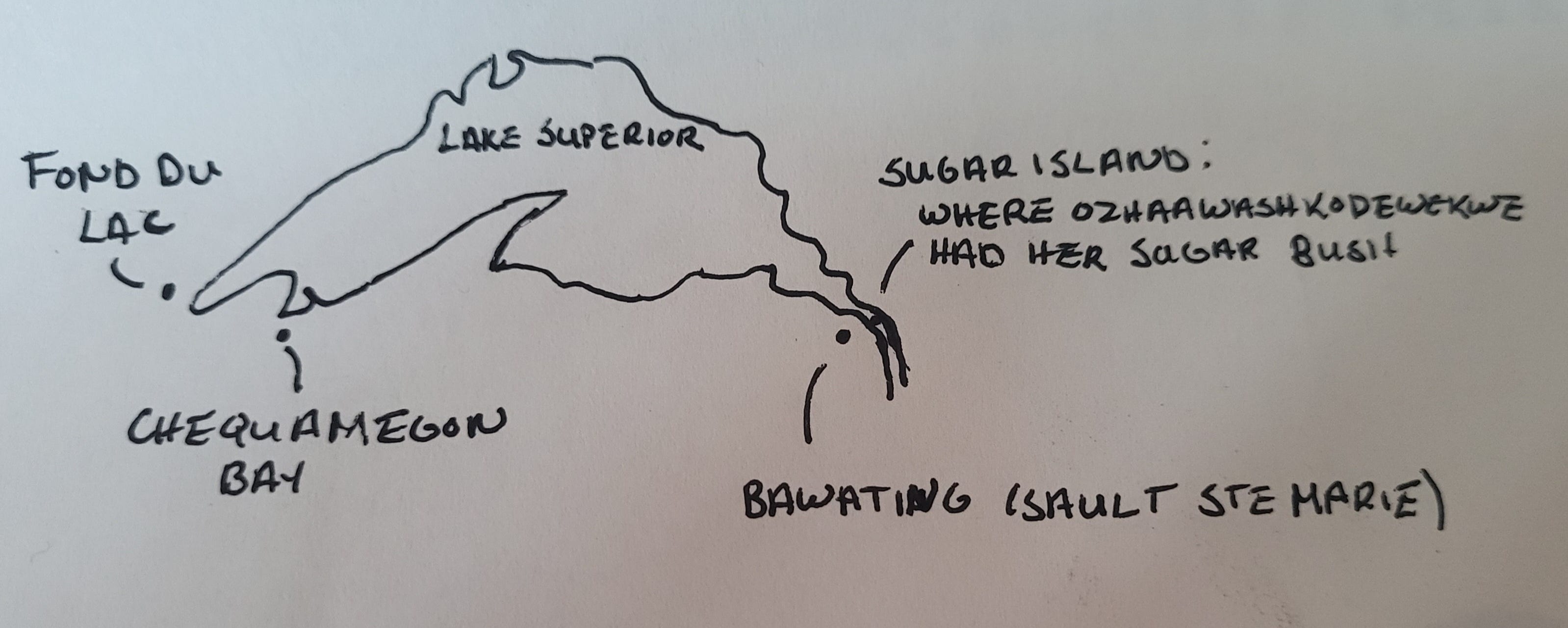
A simplified map showing sites along the South Shore of Lake Superior that were significant in Ozhaawashkodwekwe’s life. Map drawn by the author.
It’s also important to note that her marriage to Johnston was arranged by her father, Waubojiig. The marriage was not an individual decision but reflected the will of her kinship network and council fire. This context is essential to understanding her actions as collective, not merely personal or familial.
Other families were also included in the 1826 land grants. Ozhaawashkodewekwe advocated for women who used kinship and marriage to bring outsiders like fur traders into their networks. These women included Ikwezewe (also known as Equaysayway or Madeline Cadotte), wife of Michael Cadotte and Tiigasa, wife of Charles H. Oakes.
Despite her efforts and Schoolcraft’s political maneuvering, the Senate refused to ratify the land grants. Ozhaawashkodewekwe did not become the legal owner of her Sugar Island land. Still, she continued to manage her sugar bush. The U.S. government’s refusal to recognize her property did not undo her inherited clan rights or responsibilities.
The 1826 Treaty of Fond du Lac was the last treaty Ozhaawashkodewekwe participated in. It marked a period of major political transition, including the finalization of the international border between American and British waters in the St. Mary’s River. Both nations initially claimed Sugar Island. The Americans argued that Ojibwe acknowledgment of U.S. claims to the island in the 1826 treaty justified their ownership. The island appeared in the treaty only because Ozhaawashkodewekwe lobbied for land grants and asserted her longstanding use of the area.
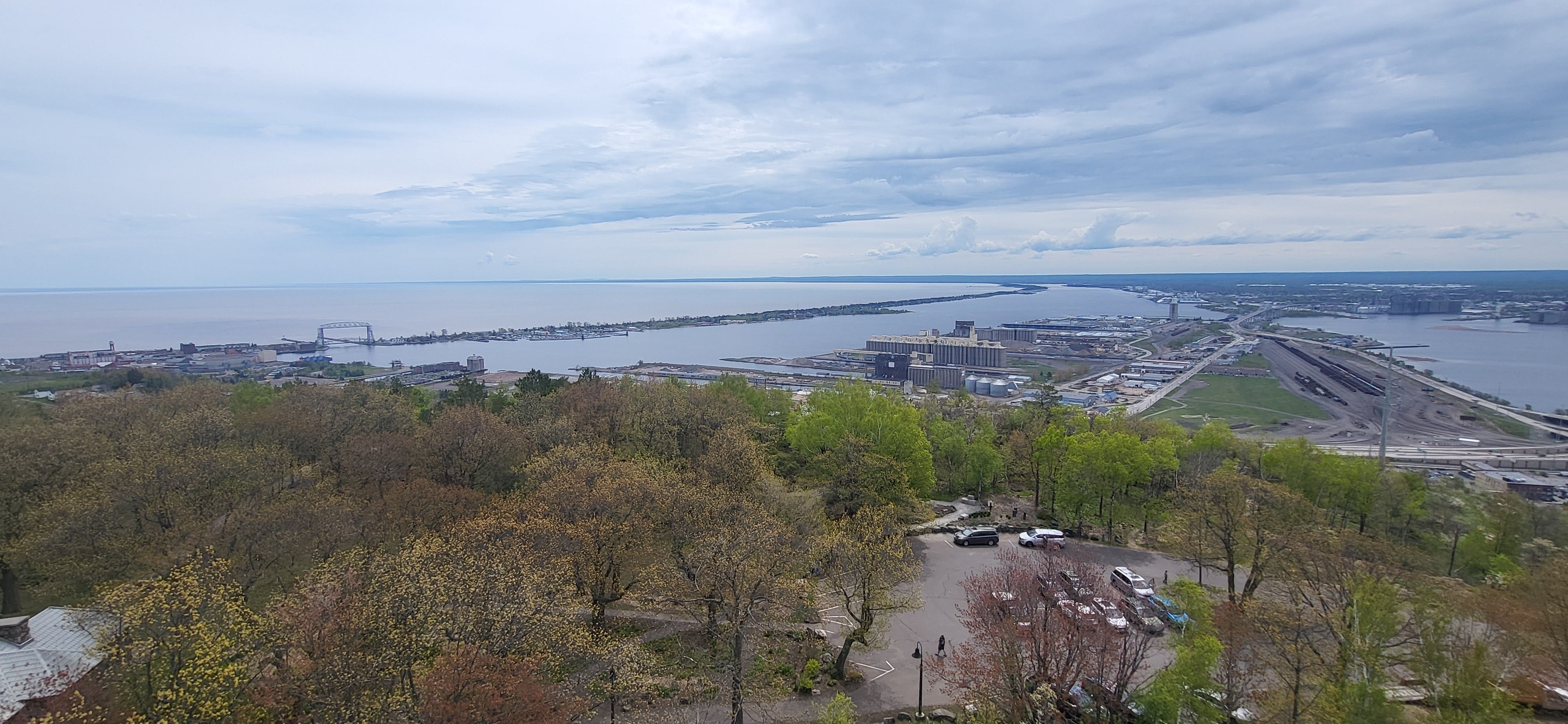
A present-day view of Duluth, Minnesota (present-day Fond du Lac), with Superior, Wisconsin, in the distance. Photo by the author.
Still, the United States used this language to its advantage in negotiations with Britain. Sugar Island was never mentioned in subsequent land cession treaties. Yet in 1842, the British agreed to U.S. control over the island in the Webster–Ashburton Treaty.
The Treaty of Fond du Lac reveals how Ojibwe leaders, including women like Ozhaawashkodewekwe, exercised political agency in the face of increasing U.S. pressure. While American officials sought mineral rights and exclusive influence, Ojibwe leaders negotiated strategically to assert kinship, protect land use, and support future generations. Understanding this history challenges simplified narratives about power and influence in treaty-making and reminds us that Indigenous women were not just participants in these events—they were central to shaping them.
In remembrance of the Treaty of Fond du Lac and legacy of the nineteenth-century political work of Ojibwe women, consider: what do we lose when we overlook the leadership of Indigenous women in our histories?
My research on Ozhaawashkodewekwe is published in Emily Macgillivray, “From Sugar Bush to Treaty Councils: Ozhaawashkodewekwe’s Career in the Nineteenth Century Borderland Upper Great Lakes,” (Journal of Ethnohistory 71:4; October 2024, 471-96). If you would like a copy, please contact me!
I grew up in Superior, WI and never really knew of this history. Fascinating stuff
Fascinating, thank you