
Many Wisconsinites associate the Northwoods with inland lakes lined by white pine. But before the white pine was associated with the iconic beauty of the Northwoods, it shaped many aspects of the state's history.
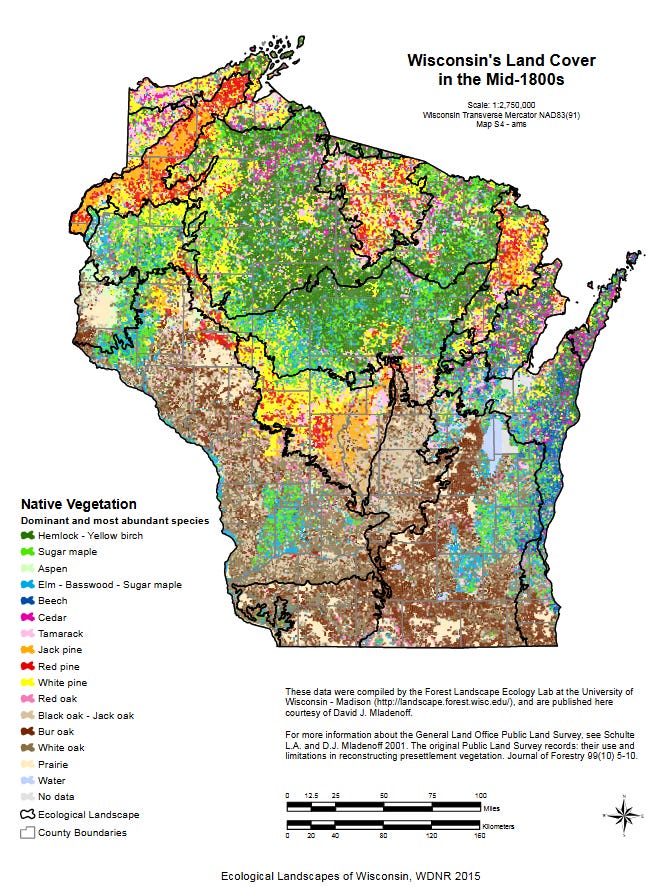
A map created by Wisconsin Department of Natural Resources showing the predominant trees throughout the state in the mid-1800s. White pine is shown in yellow.
On July 29, 1837, Ojibwe leaders from (what we now know as) the northern Wisconsin-Minnesota border area met with American officials at the confluence of the Mississippi and Minnesota River. This meeting led to the signing of the Treaty of St. Peters, which ceded a large portion of land in northwestern Wisconsin and a small section of land in Minnesota. This treaty is now commonly known as the Pine Treaty, and along with being one of the major land cession treaties in northern Wisconsin, this treaty is also important because it recognizes Ojibwe people’s right to hunt, fish, and gather on ceded territory. These rights, known as usufructuary rights, are important ways that Ojibwe people continue to exercise their sovereignty in the present.
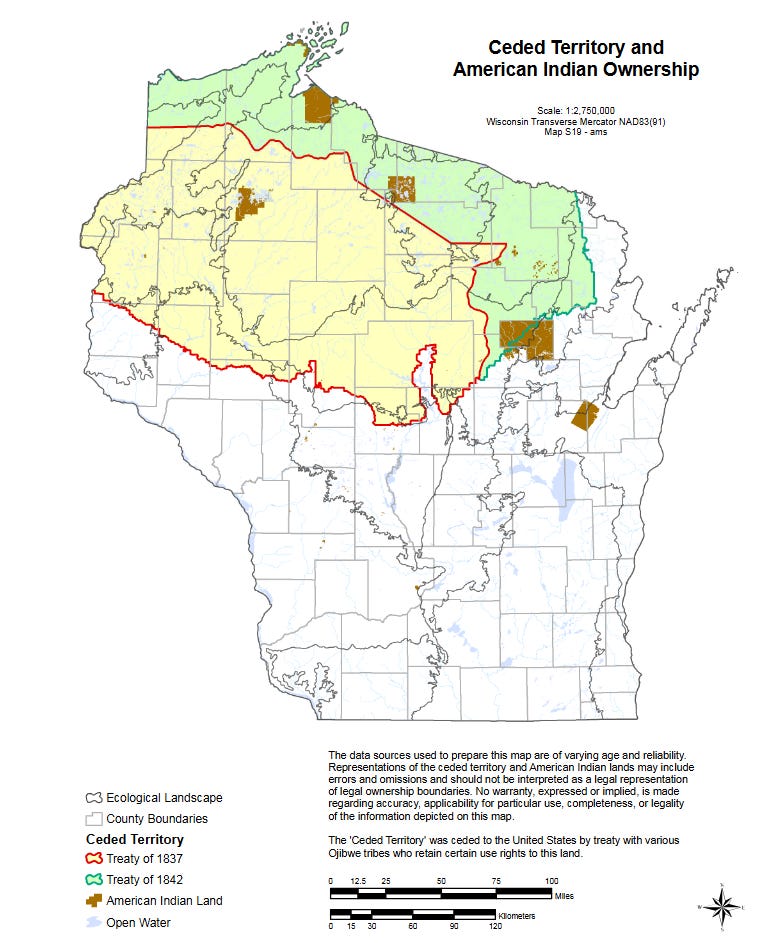
Map created by the Wisconsin Department of Natural Resources. The Pine Treaty is referred to as the Treaty of 1837 and shown in yellow.
This treaty is also an important turning point in Wisconsin history, ushering in the logging era to the Northwoods. Lumber camps sprang up throughout the region and American settlers (many who were recently arrived immigrants) flocked to the camps for jobs. Initially, old growth white pine was cut and floated down rivers and lakes to sawmills for processing. Dams were created to raise water levels in the rivers to make it easier to float the rafts of logs. By the turn of the twentieth century, most of the white pine was cut. But the creation of railroads meant hardwoods (which didn't float) could be cut and transported to sawmills.
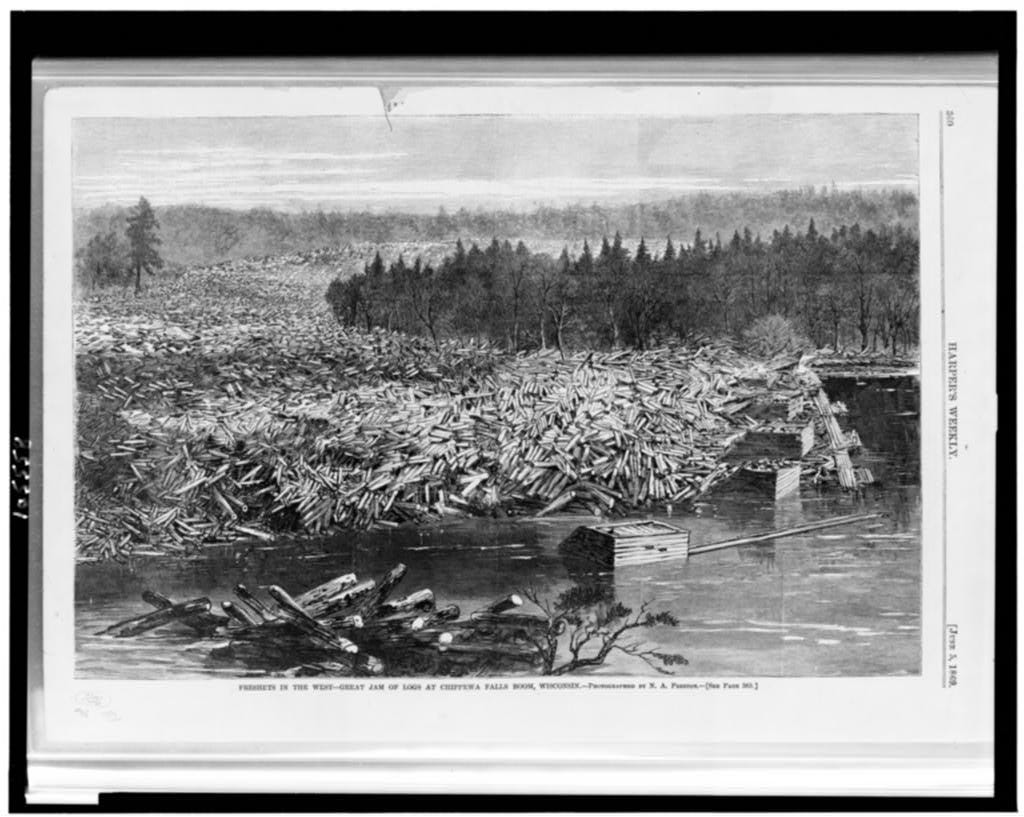
A log jam near Chippewa Falls in 1869. This photo illustrates the immense size of the log jams that formed on rivers during the logging boom in the second half of the nineteenth century. Dynamite was usually needed to dislodge log jams of this extent. Image available from the Library of Congress.
Ojibwe people did not leave the region after the Pine Treaty and other land cession treaties were signed. Despite some removal schemes orchestrated by government officials (like the Sandy Lake Tragedy), Ojibwe people continued to live in the area, hunting, fishing, and gathering as their ancestors had for generations. The seasonal nature of the lumber camps meant that Ojibwe men could continue to practice traditional seasonal food ways while also working in the camps. Logging led to long term environmental changes, including increased erosion in rivers and increased water levels on lakes, affecting vital fisheries and wild rice stands. By earning wages in lumber camps Ojibwe men adapted to these changes by supplementing their diets by purchasing foods from trading posts and stores.
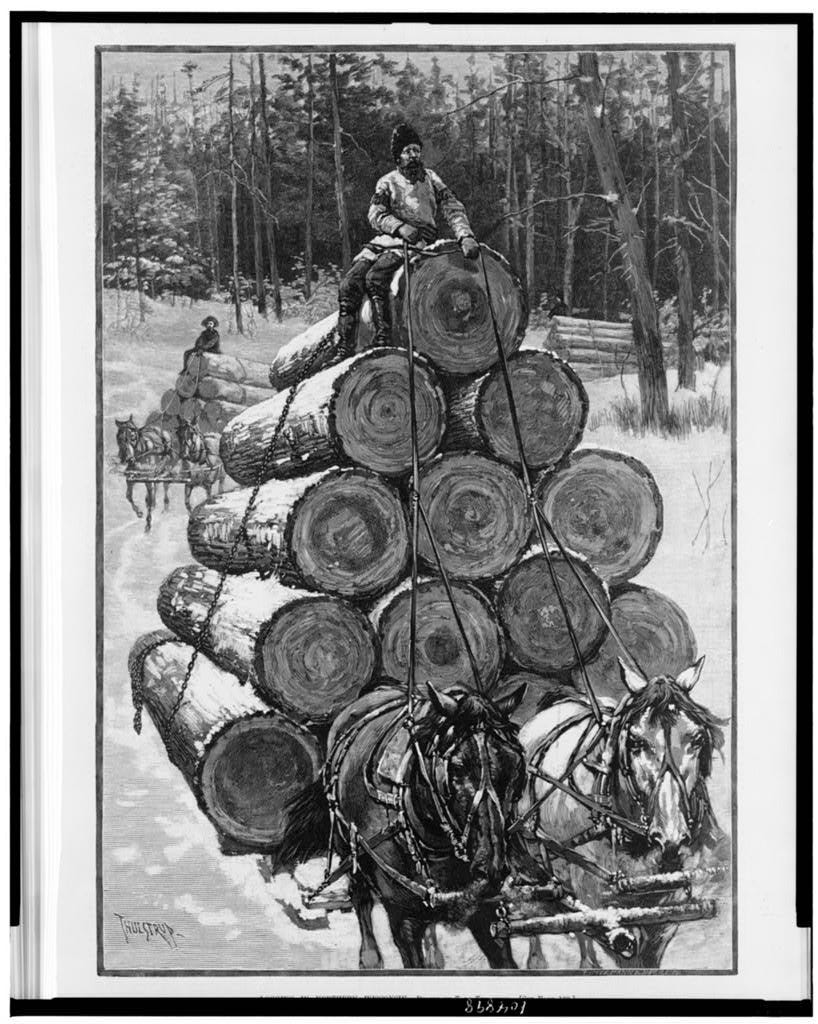
A wood engraving by Thure DeThulstrup published in Harper’s Weekly in 1885 illustrating the size of white pine that was cut in northern Wisconsin. Image available from the Library of Congress.
Even after reservations were formed in northern Wisconsin after the second Treaty of La Pointe in 1854, Ojibwe peoples continued to move freely between reservations and logging camps on ceded territory. As the nineteenth century progressed, state officials (like game wardens) increasingly persecuted and criminalized Ojibwe people for practicing their usufructuary rights on ceded territory. Many Ojibwe people were arrested. Giishkitawag, an Ojibwe civil leader from the Rice Lake area (also known as Joe White), was killed in 1894 after game wardens accused him of hunting deer and proceeded to shoot him and beat him to death in front of his family members and friends. The case went to trial and the jury found the wardens not guilty, despite numerous witness (both Ojibwe and Americans) who testified about the wardens actions and motives. This is an example of how as American settlement and legal institutions expanded into northern Wisconsin Ojibwe legal systems suppressed at the same time as Ojibwe people were denied equal protection under American law.
As northern Wisconsin and neighboring states were cutover, loggers left behind piles of slash, or waste, which often ended up burning in massive wildfires that started through the northern Great Lakes. The cutover era introduced an era of forest fires, including some that burned so hot they damaged the soil. In the barren landscape left behind by logging companies and the fires, many settlers moved into the area searching for cheap land to develop homesteads and farms. However, the soils in much of the region were not suitable for agriculture due to high amounts of either sand or clay. As a result, many landowners didn't stay in the region. Some sold their lands outright, while others experienced foreclosures. Often, land that was foreclosed returned to counties. Some of these properties became part of what we now know today as public lands, like county forests.
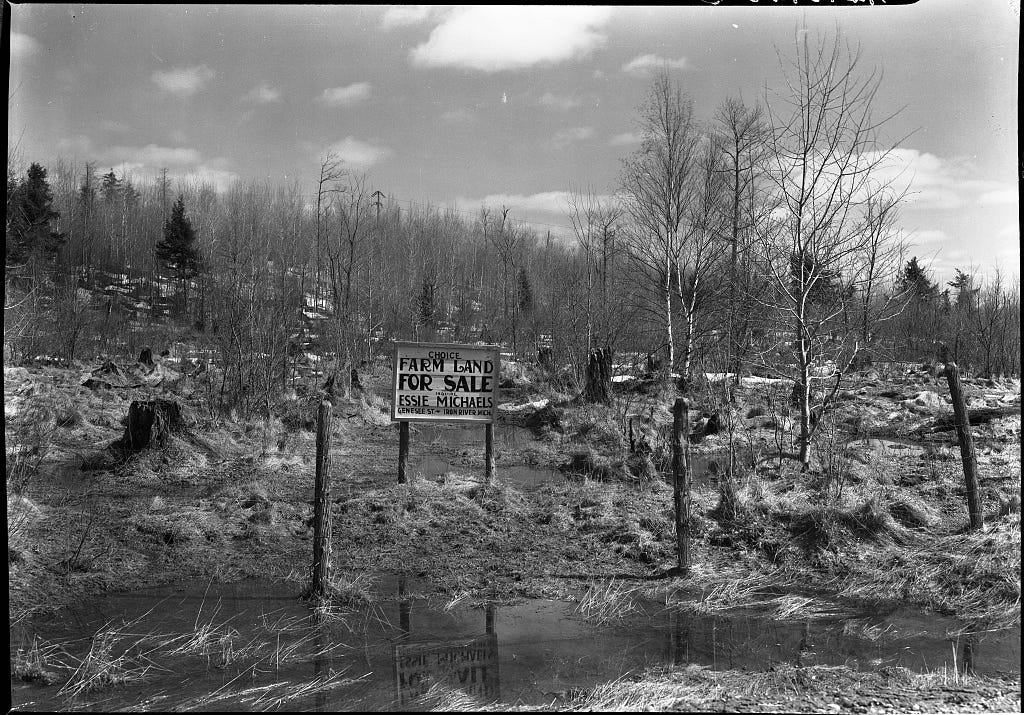
Cutover land for sale near Iron River, Michigan, in the western Upper Peninsula of Michigan in 1937. This area was ceded by the Treaty of La Pointe in 1842. This image is available from the Library of Congress.
During the second half of the nineteenth century, white pine drove the economy of northern Wisconsin and adjacent states. The United States got 240 billion board feet of timber from the Ojibwe lands ceded in the Treaty of St. Peters in 1837 ("The Pine Treaty") and the subsequent Treaty of La Pointe in 1842 (often known as "The Copper Treaty"). Economic historian David Wrone argues that the acquisition of Ojibwe territory throughout American territory in the northern Great Lakes changed the nation: "[These lands] provided several of the essential ingredients for the industrial transformation of late nineteenth- century and early twentieth- century America. The ores of the Mesabi enabled the steel mills of Pittsburgh to flourish, the copper of the Keewnanh [Keeweenaw] poured into wires made the telephone system possible. Power sites created paper mills, part of the industrial glory of Wisconsin. The lakes and fish offered a recreational paradise."
Today, when you drive through land ceded by the Pine Treaty, you'll see the occasional old growth white pine that escaped the saws of loggers. You'll also notice some younger pine that grew in the wake of the cutover. You'll find many inland lakes that are the heart of the vacations and recreational activities many people associate with the Northwoods. You'll go through cities and villages that were founded during the logging era--the population of these communities grew until the land was cutover. Then, in the wake of the lumber boom, often their populations drastically declined, illustrating the dynamics of boom-bust economies focused on extractive industries. You'll also notice fields of hay, corn, and other crops, remember that most of that land was forested before the mid-nineteenth century. You are looking at the legacy of the cutover, which was an era ushered in by the Pine Treaty.
Works Cited
David R. Wrone, “The Economic Impact of the 1837 and 1842 Chippewa Treaties,” American Indian Quarterly 17:3 (Summer 1993), 329-340.
To learn more about how Ojibwe people in northwestern Wisconsin were affected by the logging era, including how they were persecuted for practicing their treaty rights, I recommend Erik Redix's, The Murder of Joe White: Ojibwe Leadership and Colonialism in Wisconsin, (Michigan State University Press, 2014).
To learn more about Ojibwe peoples’ labor in lumber camps, I recommend Chantal Norgard’s Seasons of Change: Labor, Treaty Rights, and Ojibwe Nationhood, (University of North Carolina Press, 2015).