
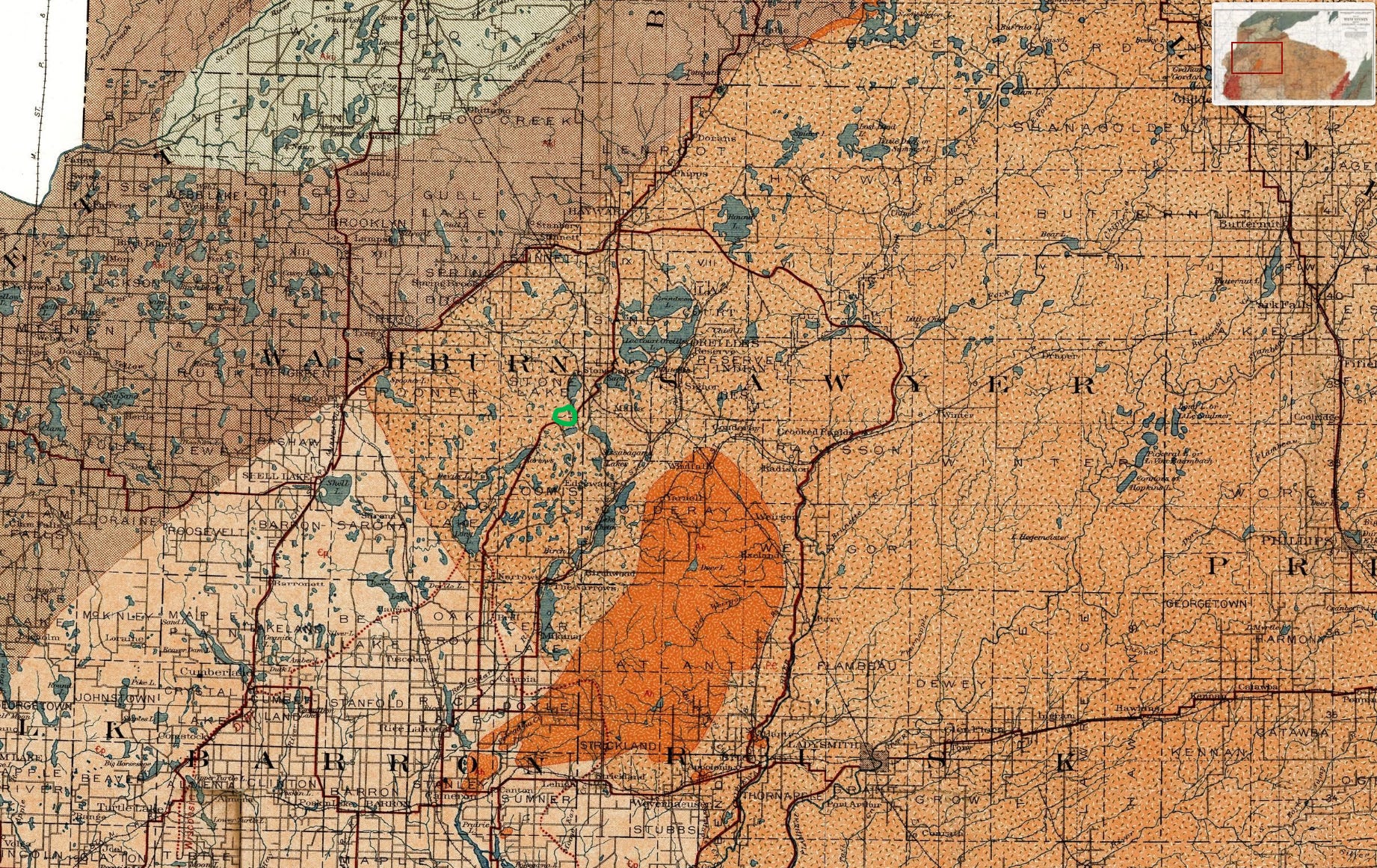
The snow was already on the ground near Long Lake in Washburn County, Wisconsin, on December 13, 1894. Giishkitawag, an Ojibwe leader also known as “Joe White,” was doing what his ancestors had done for millenniums: providing for his family. He was traveling with his wife, children, and friends, moving between the reservation created half a century ago and the ceded territories that were his home.
He was not just a man walking through the woods; he was a member of a sovereign nation exercising a legal and inherent right.
But in 1894, the State of Wisconsin did not see a sovereign leader. They saw a poacher and a threat to American authority.
When Deputy Game Warden Horace Martin and his assistant, Josiah Hicks, intercepted the group, they weren’t just enforcing “conservation” laws. They were enforcing American authority in the Northwoods. They arrested Giishkitawag for hunting deer out of season, using a state statute to illegally supersede federal treaty stipulations.
At first, Giishkitawag complied. But when the wardens attempted to handcuff him, criminalizing him, the situation escalated.
This Substack is supported by readers. If you like what you are reading, please consider subscribing! There are free and paid options.
The forensic evidence and eyewitness accounts tell a brutal story, one that contradicts the official report. They show that the wardens clubbed Giishkitawag in the head with a rifle. As he fled for his life, Deputy Martin raised his weapon and shot him in the back from nearly 30 yards away.
Giishkitawag died two hours later. The wardens claimed self-defense, alleging Giishkitawag had a knife. No knife was ever found on his body or at the scene.
The War on Subsistence
To understand why Giishkitawag was killed, we have to look beyond a single violent encounter. We have to look at the treaties themselves.
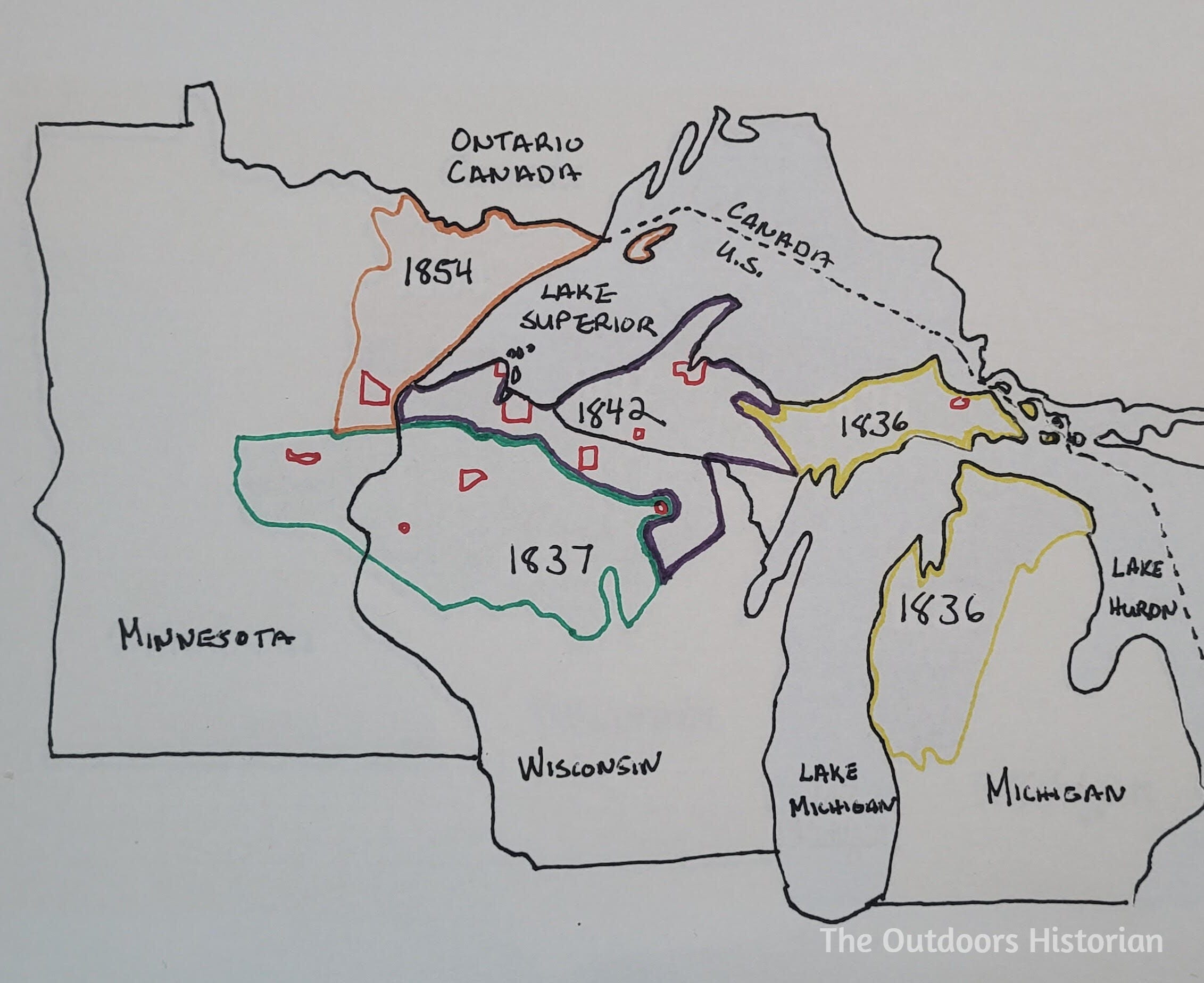
Giishkitawag’s ancestors had signed treaties in 1837, 1842, and 1854. In these documents, the Ojibwe ceded vast tracts of land to the United States but explicitly retained their usufructuary rights—the right to hunt, fish, and gather on ceded lands.
“The privilege of hunting, fishing, and gathering the wild rice, upon the lands, the rivers and the lakes included in the territory ceded, is guaranteed to the Indians, during the pleasure of the President of the United States.”
These were not gifts from the government; they were stipulations of sale, as legally binding as a property deed. However, in the wake of these treaties, states in the Northwoods sought to erase Ojibwe sovereignty. They used “conservation” laws as a bludgeon to force Ojibwe people off ceded lands and confine them to reservations.
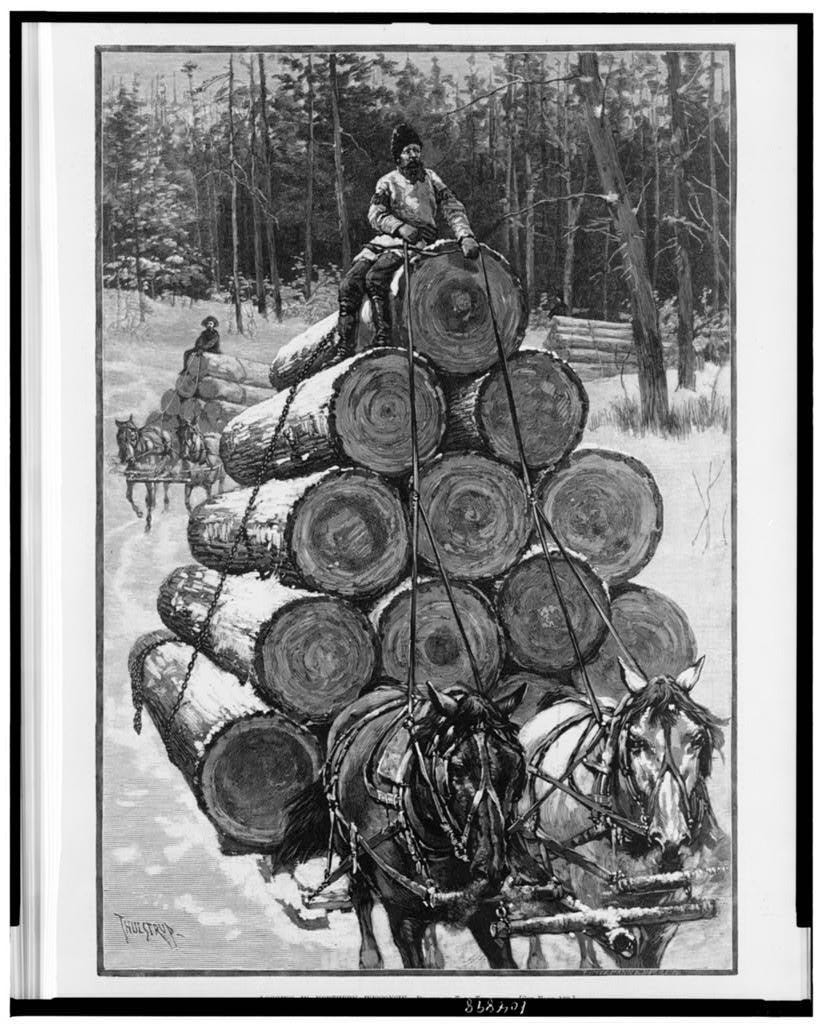
The strategy was economic coercion: by criminalizing the seasonal rounds that included hunting, the state attempted to starve Ojibwe people into compliance. If a hunter was jailed, he could not feed his family. If Ojibwe people were confined to reservations, the vast timber resources on ceded territory were left open for private logging companies and newly arrived immigrants.
Giishkitawag was a target because he refused to be confined. He lived the reality of Ojibwe sovereignty: working in logging camps on ceded territory and feeding his family off the land, regardless of state lines.
From Long Lake to the Supreme Court
The murder of Giishkitawag was followed by a failure of justice that resonates to this day. Although the district attorney filed murder charges, the trial revealed a deep racial fracture in the community.
On one side, several white men took the stand in Giishkitawag’s defense. These were men who had worked alongside him in logging camps or knew him from the community; they testified to his character and contradicted the claim that he was dangerous.
But the jury was not composed of his peers. It was composed largely of recent immigrants and newcomers who knew Ojibwe people only through the racist caricatures in the press. To them, the wardens were protecting state resources, while Giishkitawag was merely an obstacle to progress. They found Martin and Hicks acted in self-defense and declared them innocent.
The local press celebrated the verdict with chilling callousness. In an article headlined “Justifiable Homicide,” The Rice Lake Chronotype declared the acquittal was justice for everyone, “with the possible exception of the tax-payers of Washburn county, who have had a needless bill of expense saddled upon them.”
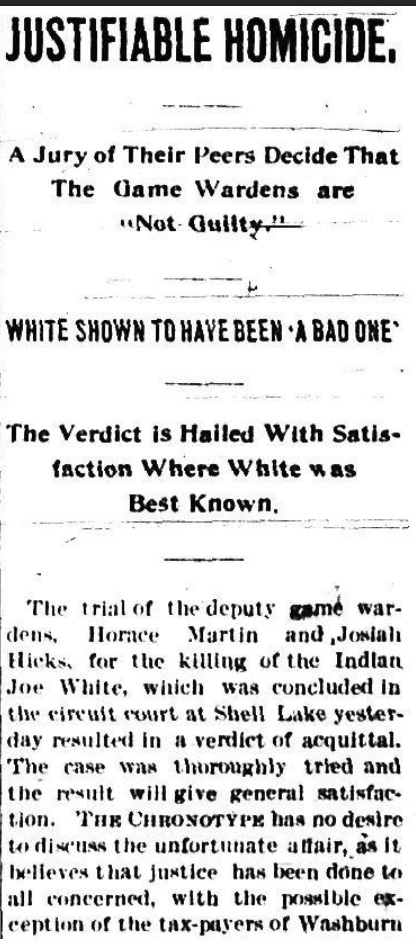
The message from the press was clear: Giishkitawag’s life was not even worth the cost of a trial. The article concluded that “the taking of Joe White’s life was not only justifiable, but an imperative necessity.”
For the Lake Superior Ojibwe, Giishkitawag’s death was not an isolated tragedy. It marked a state declaration of war on their treaty rights.
Throughout the 20th century, Ojibwe people continued to be persecuted for fishing and hunting, but they refused to stop. This resistance culminated in landmark decisions like Lac Courte Oreilles Band of Chippewa Indians v. Lester P. Voigt (1983). The federal courts reaffirmed what the Ojibwe had known since 1837: state law cannot override federal treaties. The rights Giishkitawag died for were valid, living laws.
Yet, the court’s decision sparked a new wave of backlash. In the 1980s, racist protests broke out at boat landings throughout the Northwoods. With slogans threatening violence against Indigenous fishers, Wisconsin gained national infamy as “The Mississippi of the North.”
It took years of federal intervention and Ojibwe resilience to quell the violence. Today, the state of Wisconsin and Ojibwe nations have entered an era of co-management, guided by organizations like the Great Lakes Indian Fish and Wildlife Commission (GLIFWC).
The Legacy
If you call northwestern Wisconsin home or visit it today, you are moving through a landscape defined by this history. The transition of this region from an Ojibwe-dominant space to an American state where white people were the demographic majority wasn’t a peaceful evolution. It was achieved through the pressure of removal, the imposition of state game laws, and, too often, the barrel of a warden’s gun.
As people who love the outdoors, we often celebrate the conservation movement. But we must honestly reckon with its origins. At the turn of the 20th century, conservation wasn’t just about saving deer; it was about controlling who belonged in the woods.
Continue Exploring
The Murder of Joe White: For a deep dive into this specific history, I highly recommend Erik Redix’s book, The Murder of Joe White: Ojibwe Leadership and Colonialism in Wisconsin.
The Legal Battle: To understand the 20th-century fight for treaty rights, watch the Ogichidaa Warrior series by the Great Lakes Indian Fish and Wildlife Commission.
Thank you for this important story. I’ve been researching the Wisconsin “walleye war” in the 1980s and it all goes back to Joe White.