
On June 14, 1671, Simon-François Daumont de Saint-Lusson, a French military officer, climbed to the height of land near the St. Mary’s River, planted a cross and a cedar pole bearing the king’s coat of arms, and claimed the land from Montreal to the Gulf of Mexico, including the entire Great Lakes region and interior of the continent on behalf of the King of France. The St. Mary’s River connects Lake Superior—the largest, deepest, coldest, and most northern of the Great Lakes—with Lake Huron and the rest of the lower lakes.
Saint-Lusson paddled to the St. Mary’s River from Montreal on orders issued by Jean Talon, the Intendant of New France—France’s North American colony. Claude Dablon, a Jesuit missionary, recorded the event. Another Jesuit, Claude-Jean Allouez, interpreted and enacted Saint-Lusson’s words to the Anishinaabe and other Indigenous peoples (including Menominee, Ho-Chunk, and Sauk) gathered at the council. This event has sometimes been described as a pageant with muskets, hymns, and a bonfire. Other influential attendees included explorers and fur traders Louis Joliet and Nicholas Perrot.
The ceremony took place near Sault Ste. Marie, a Jesuit mission. To the Anishinaabe, the site was known as Bawating, a name which means place of the rapids and the gathering place. While the French claimed territorial possession of the region, the northern Great Lakes remained an Indigenous space on the ground and the French had little power or ability control Anishinaabe or other Indigenous peoples.
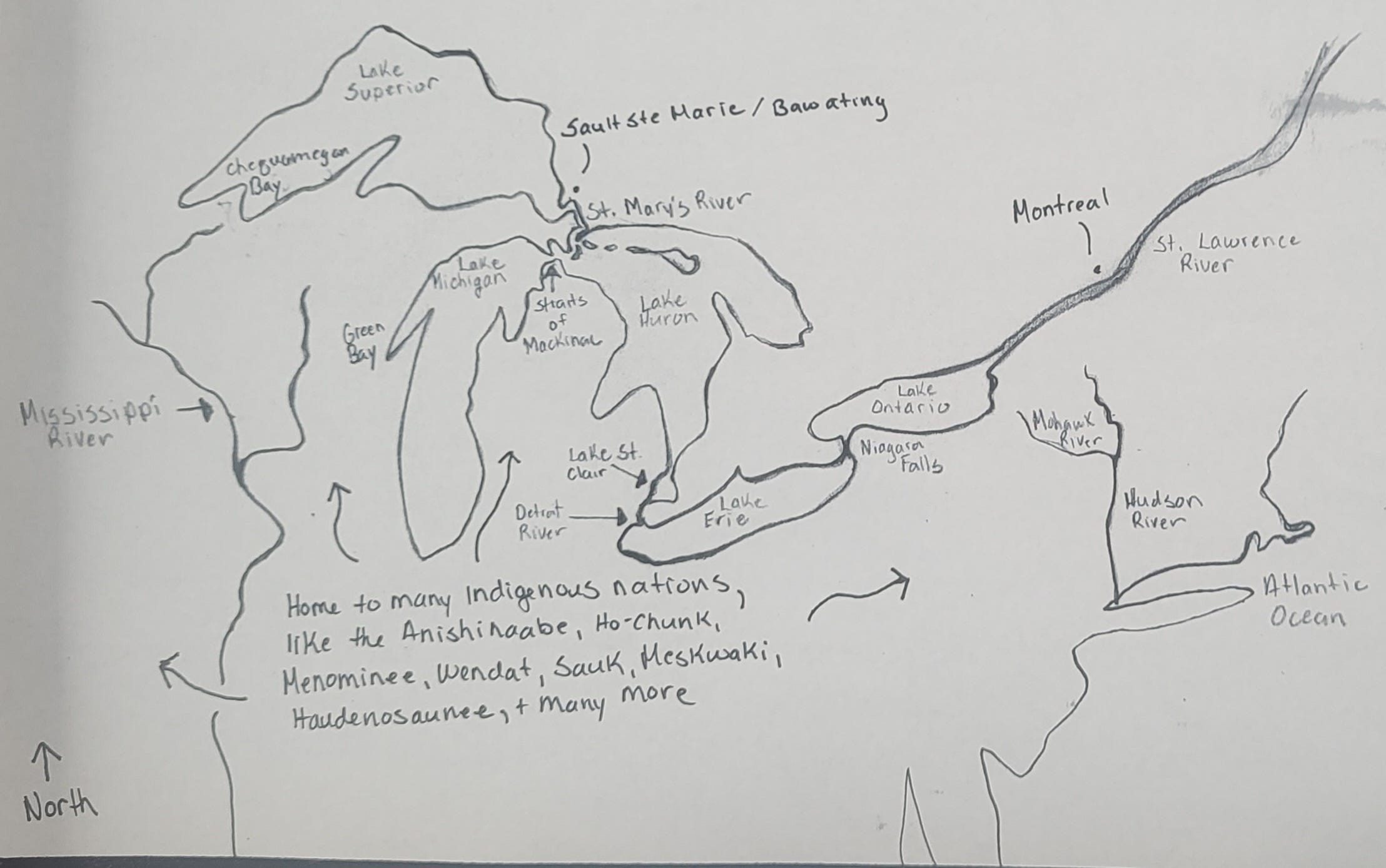
A rough sketch of a map of the seventeenth century Great Lakes. Created by the author.
Saint-Lusson’s ceremony symbolized the myth of French possession, not actual French control over the territory. This power dynamic is represented in demographics. In the Great Lakes and throughout the interior of the continent French missionaries, traders, and military officers were in the minority. They were vastly outnumbered by Indigenous peoples, who were part of vast and complex political and economic networks.
The term Anishinaabe is often translated as first or original humans. It is a collective identity that includes the Ojibwe, Odawa, Bodéwadmi (Potawatomi), and Mississauga, as well as smaller bands living in the interior north of Lake Superior and north toward Hudson’s Bay. The French referred to these people as many small Algonquian nations.
For instance, reports from Saint-Lusson’s ceremony and other 17th century ceremonies mention the “Amikouai” or “Amikwas” nation. This word means “beaver” in Anishinaabe languages and referred to a clan identity. The “Oumisagi” or “Mississuaga” referred to the “mouth of the river”, describing Anishinaabe peoples who lived at a village at this location.
Most French people in the region didn’t understand these identities. They mistakenly imagined the northern Great Lakes as home to disorganized and scattered refugee communities, dispersed by warfare with other Indigenous nations. However, from the Anishinaabe perspective, the region was a sophisticated arrangement of social relationships organized around village centers, trade routes, ritual ceremonies, hunting territories and resources like fisheries, hunting grounds, maple groves, and wild rice stands.
For instance, people who identified as Saulteurs at Sault Ste Marie, might also identity as Awasse, Monsoni, or Ni-ka when hunting in the swampy region north and west of Lake Superior. Why? Because these were all names of clans with a right to hunt in this region. In the different places these peoples traveled, Anishinaabe peoples used names that would make them legible and understandable to other Indigenous people in the region and signal their place in this complex network of kinship and diplomacy.
Despite French misunderstanding about the Anishinaabe political world, they learned to communicate with each other through taking part in various social customs and institutions that had similarities in both societies. When Allouez translated Saint-Lusson’s ceremony to the Anishinaabe and other Indigenous peoples, he described a Franch father drenched in the blood of his enemies, capable of making the earth tremble with a power greater than thunder and in possession of unending supply of captives and trade goods. This description was one that both French men who practiced Christianity and Anishinaabe peoples in the northern Great Lakes could understand.
According to Anishinaabe historian Michael Witgen, ritualized violence—the power to destroy the bodies of enemies and restores the bodies of his allies—defined the power of Gichi-Manidoo, or the greatest of spirit beings. In essence, when Allouez described the French King as the greatest of all leaders, the Anishinaabe saw the French King as a powerful grandfather who could draw on the power of Gichi-Manidoo and who controlled access to weapons and trade goods that were beginning to change the region.
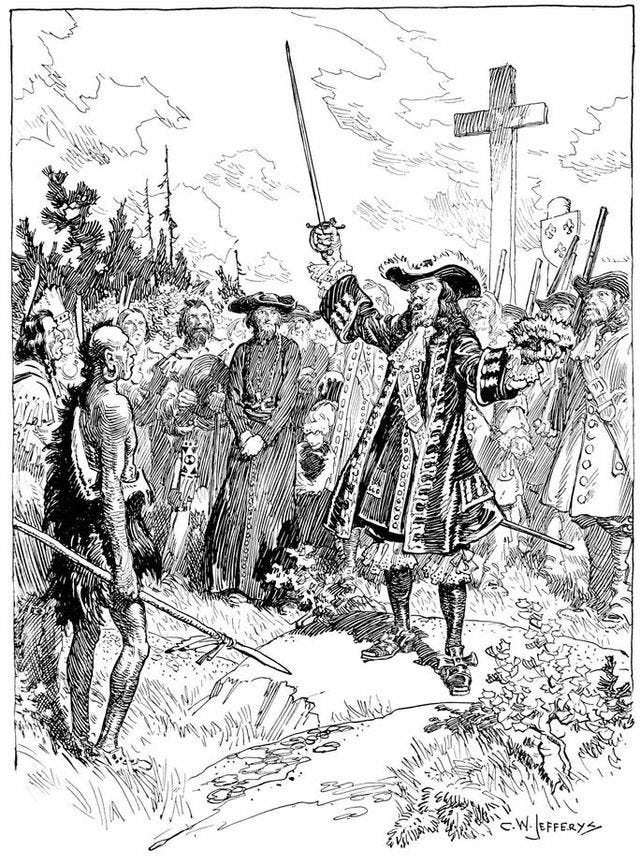
Charles William Jeffreys’ 1895 depiction of Saint-Lusson’s ceremony. Image from Wikimedia Commons.
At Saint-Lusson’s ceremony, the French believed they were claiming Indigenous lands. But the Anishinaabe did not view themselves as giving up control of the region. Instead, they saw themselves as gaining a powerful new family member who had access to valuable resources.
Saint-Lusson’s ceremony at Sault Ste. Marie is part of a pattern throughout the eighteenth and early nineteenth century of European powers (like France, Britain, and Spain) and the United States claiming spaces where they had minimal (if any) legal claim and could only exercise power on the ground when supported by strong Indigenous allies.
Just like Saint-Lusson ignored the political complexity and sovereignty of the Indigenous peoples gathered near the St. Mary’s River on June 14, 1671, today, it is still common for historians of North America to push Indigenous peoples to the sidelines, ignoring or tokenizing them. Another common issue is for historians to focus on narratives of Indigenous disappearance and ignore Indigenous politics and the ways Indigenous peoples were central to North American history.
Saint-Lusson’s ceremony is an example of how European perspectives on the seventeenth century do not reflect the reality of Indigenous peoples. The ceremony represents a myth of possession and it has important lessons for us in the twenty-first century. To accurately understand North American history, we need to pay more attention to Indigenous politics. We need to pay more attention to how Indigenous sovereignty, governance, and political systems existed before Europeans arrived on the continent, and pay more attention to the ways Indigenous peoples adapted these systems amid systematic attacks on their sovereignty as European empires, and later the United States and (British) Canada expanded west to the Pacific Coast.
Want to learn more about Indigenous politics, the limits of French power, and and Saint-Lusson’s ceremony? Check out Michael Witgen, “The Rituals of Possession: Native Identity and the Invention of Empire in 17th Century Western North America,” Ethnohistory , Volume 54, No.4, (Fall 2007), 639-668 or Chapter 2 (The Rituals of Possession and the Problems of Nation) in Michael Witgen’s An Infinity of Nations: How the Native New World Shaped Modern North America. Philadelphia: University of Pennsylvania Press, 2012. If you need access to either of these resources, let me know!
From elementary school thru college, I wondered why we didn’t learn North American history with the same detail as we did European history. We learned broad-brush Indian culture, but not history.
The answer, we knew European history because they had a written language to leave records with and the Indians didn’t, was satisfying then, but not now.
I still don’t know any.