
Welcome to The Circle Tour Series. In Fall 2024, my partner, Eugene, and I circled Lake Superior. We left our home in Bayfield, Wisconsin, and headed clockwise up the Minnesota North Shore, crossing the border into Ontario. Then we drove along the Ontario shore, crossed, the border at Sault Ste. Marie, and traveled through the UP to return home. Most of our time was spent between Sleeping Giant Provincial Park and Pukaskwa National Park. Part travelogue, part history, this series explores the intersection of industrial ruins, boreal ecology, and personal transition. It is a journey to see how landscapes survive when the systems built upon them including mines, railroads, and careers in higher education, fall apart. This is Part 2 of 5.
In Part 1, we ended our journey on top of Mount McKay, looking out at the silhouette of the Sleeping Giant. Now, it was time to drive into that view.
Despite spending my childhood summers at Whitefish Lake and my grandparents’ camp at Dog Lake, I never visited the Sibley Peninsula with my family. For the first time on this trip, I was not revisiting memories. I was making new ones.
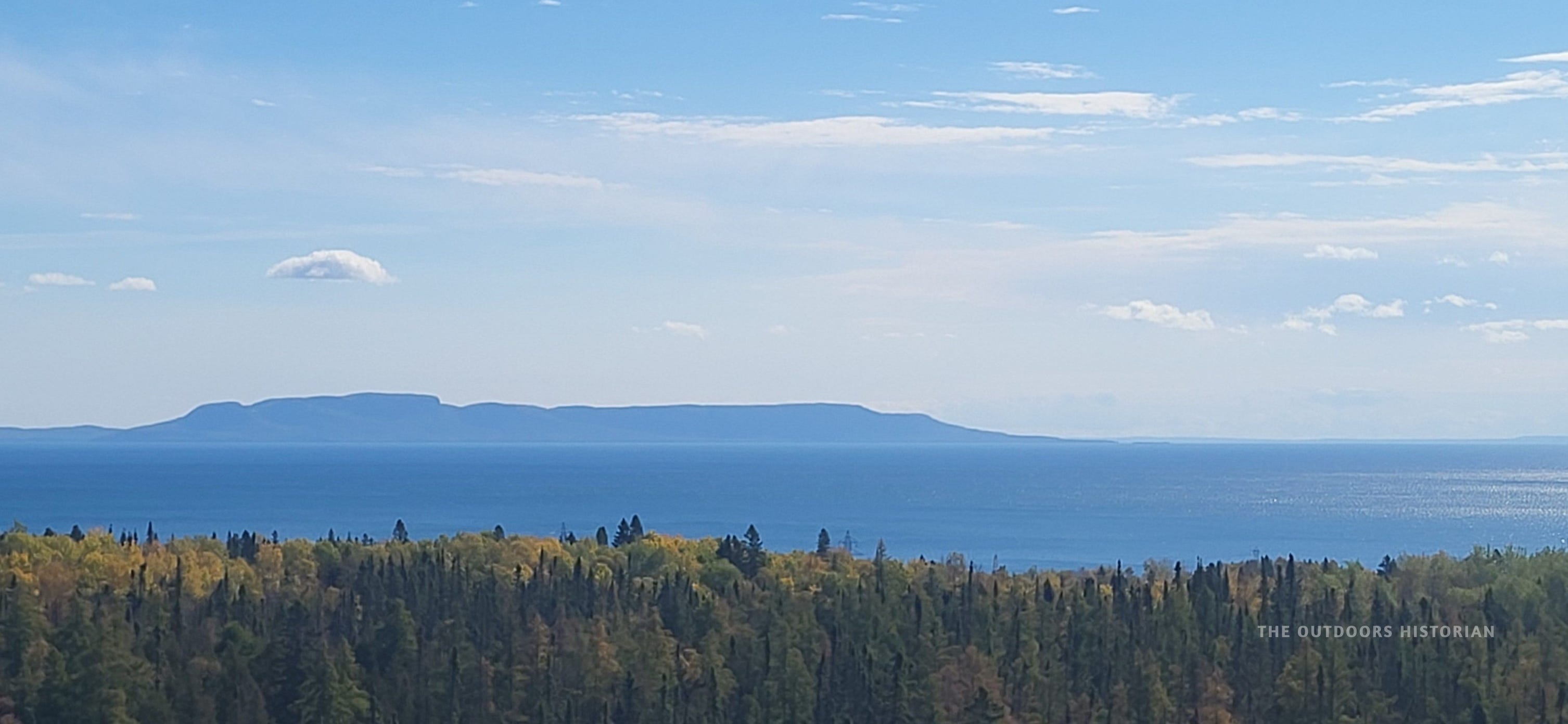
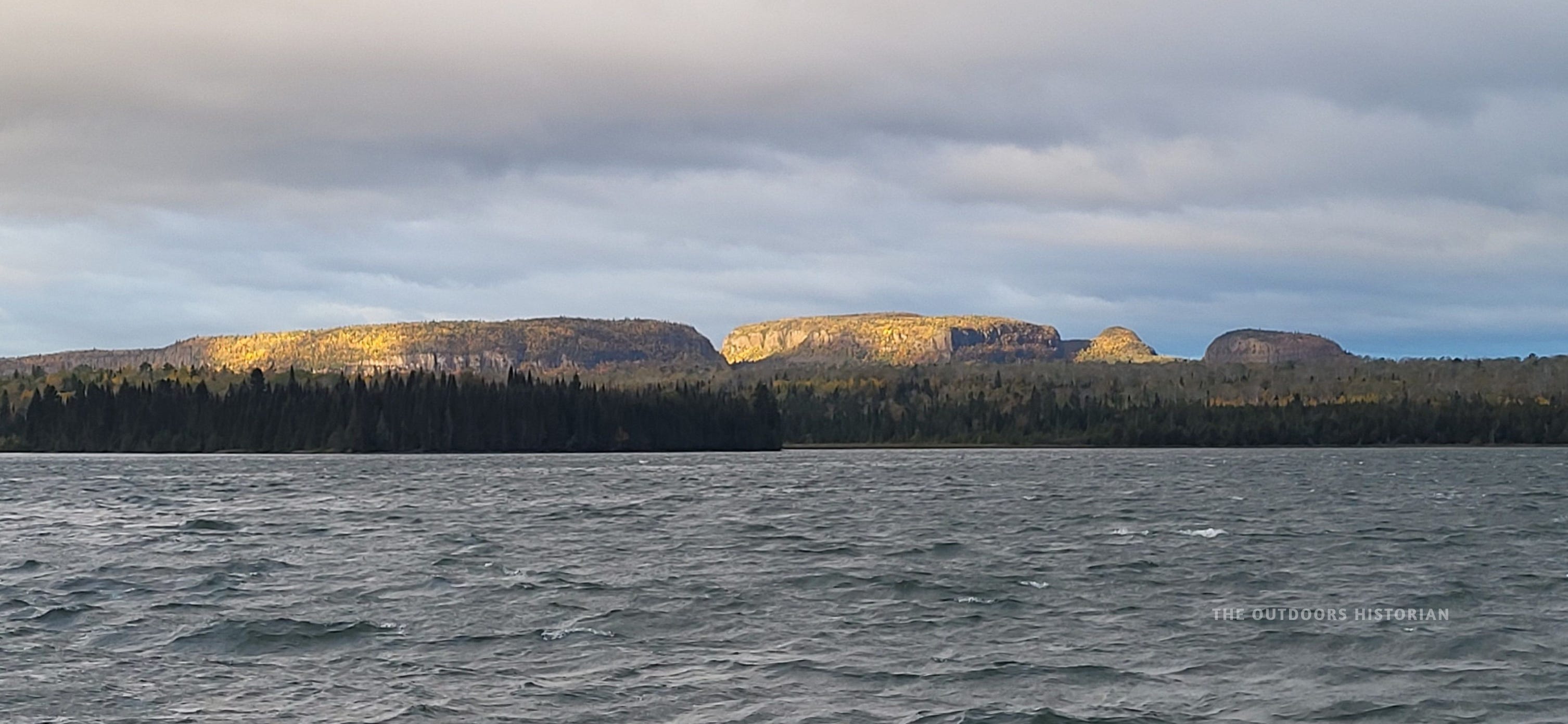
We left Whitefish and headed east, making the required stop at the Terry Fox Monument on the outskirts of Thunder Bay. The monument includes a life-sized statue. Looking across the water at the silhouette of the Sleeping Giant, you feel the weight of the layers of history. In the distance, you can see the Sleeping Giant—a geological formation created from eroded diabase sills at the tip of the Sibley Peninsula. It illustrates the predominant topography of the region (flat mesas or tablelands), but it is also distinctly unique. This particular mesa resembles a giant lying on his back. Anishinaabe stories describe the mountain as the shapeshifter and spiritual teacher Nanabozho. This is a place where the multilayered human history stretching back for generations is written across the rugged landscape.
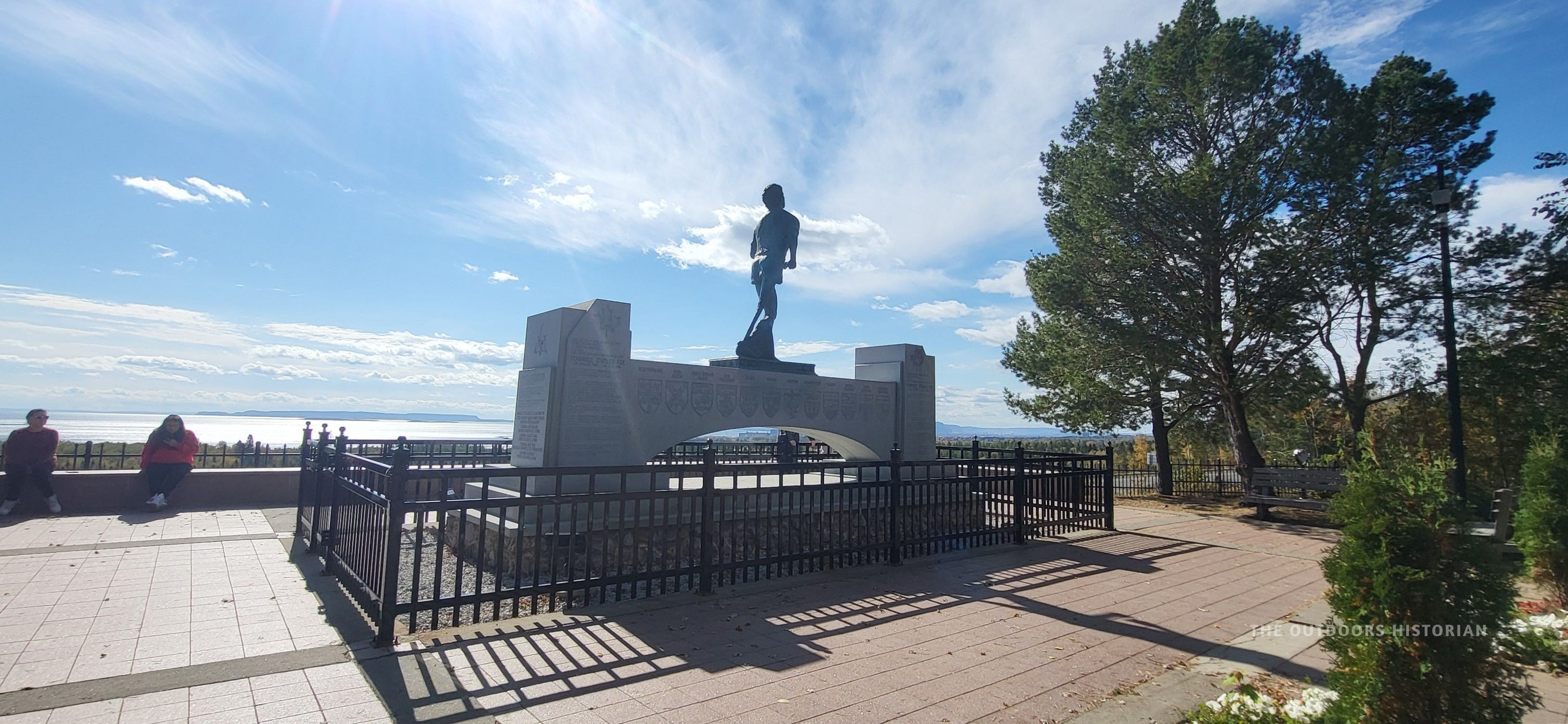
The layer of history immediately in front of us was Terry Fox. He was a young man who lost his leg to osteosarcoma and attempted to run across Canada in a “Marathon of Hope” to raise money for cancer research. He ran a marathon a day on an artificial leg for 143 days before his cancer returned and forced him to stop near this very spot. There’s also a Visitor Center at the site with restrooms and plenty of brochures and maps.
Suspended at the Intersection of Land, Lake, and Sky: The Thunder Bay Lookout
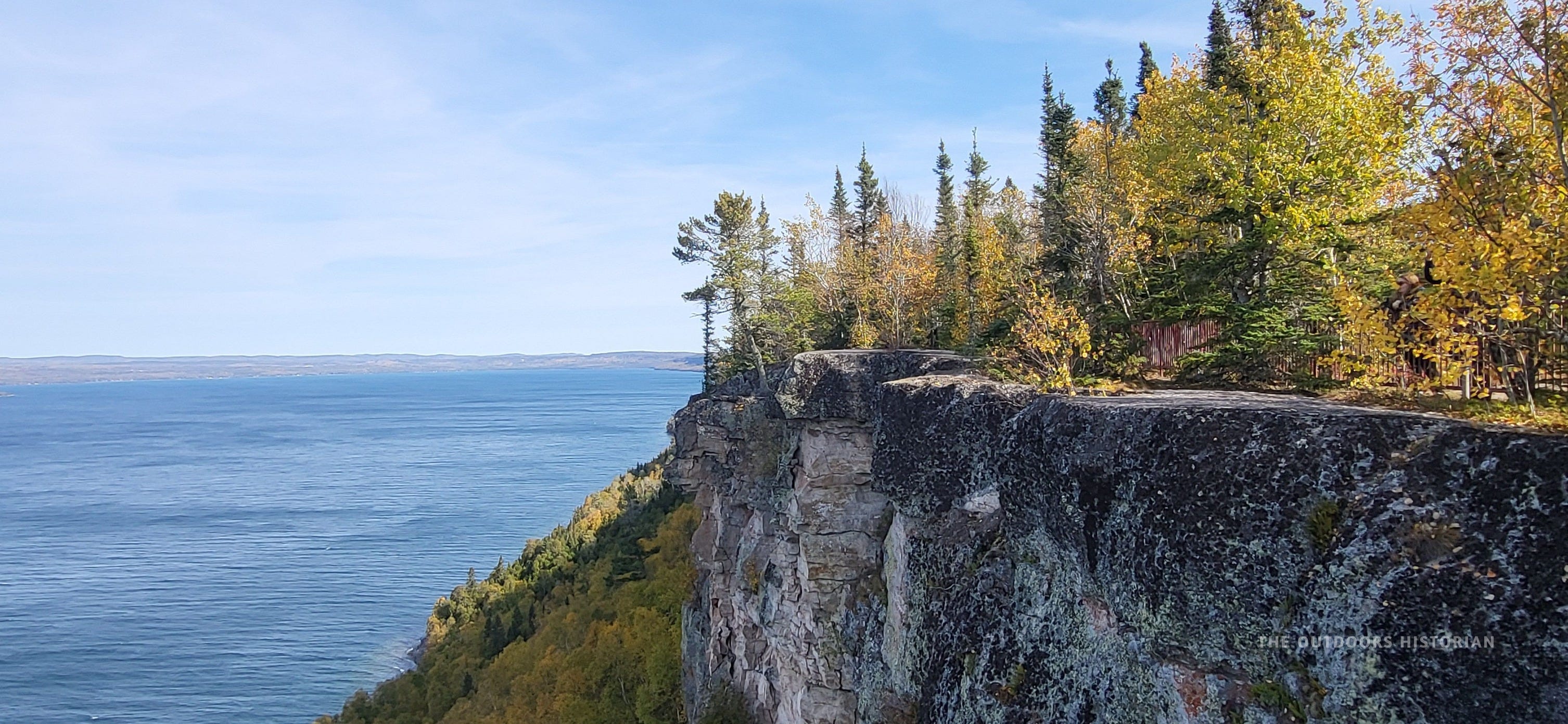
We continued our drive to Marie Louise Lake Campground in Sleeping Giant Provincial Park. On the way, we made a detour to the Thunder Bay Lookout in the park. While the signs warned us about a rough road ahead when we turned off the main highway, we found it was very mild compared to where our UP trips take us. The lookout, however, got our heartbeats up.
The lookout features a steel platform that juts out over the cliff edge. Walking out onto it is a “trippy” experience. The mesh grate allows you to look straight down through your boots to the forest floor hundreds of feet below. It creates a visceral sense of vertigo, as if the ground has vanished and you are floating.
Back in Part 1, I wrote that the sign at the Susie Islands Overlook on Mount Josephine—'Land, Lake, Sky'—became the manifesto for our trip. Standing here on the lookout, that manifesto felt literal. We were no longer just looking at the sky; we were suspended in it.


The cliff we were hanging over is a nesting ground for Peregrine Falcons. These majestic guardians choose the sheer cliffs for similar reasons as the Animikii (Thunderbirds) do: high-altitude isolation and a commanding view.
Standing on that platform taking in this view, the scale of the Ontario park system also hits you. Sleeping Giant, founded in 1944, covers 61,604 acres. This makes it similar in size to Michigan’s largest state park, the Porcupine Mountains. However, in Ontario, Sleeping Giant is considered “modest.” For context, Algonquin Provincial Park is over 1.8 million acres, and it is only the third largest provincial park in Ontario. Polar Bear Provincial Park is the largest and is over 5.8 million acres, which is over half the size of the entire Upper Peninsula.
We finished our first day on the peninsula by setting up our campsite, where we were greeted with yet more views of the Sleeping Giant. We settled in around the fire and made grilled sausages with sauteed peppers and onions for dinner.
Hiking to The Sea Lion Through a Boreal World
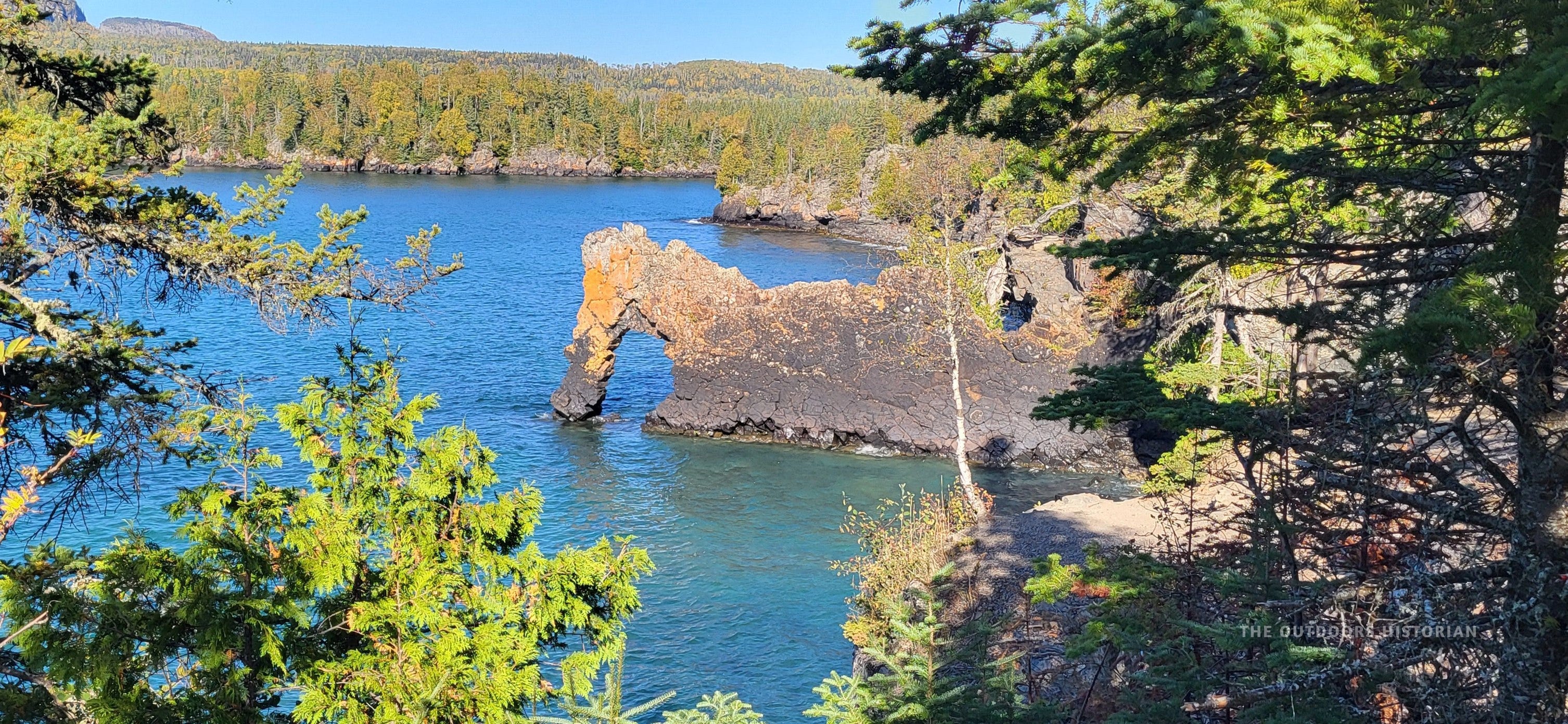
The next day, we descended from the heights to the water to hike the 2.4 km (approximately 1.5 mile) round trip Sea Lion Trail. On the trail you travel across two billion years of history. The 1.9-billion-year-old seabed of the Rove shale is beneath your feet and the 1.1-billion-year-old volcanic “tooth” of the Sea Lion stands guard against the Big Lake.
While the nearby Sleeping Giant was formed by sills—magma sliding horizontally between sedimentary layers like the filling in a sandwich—the Sea Lion is a “dike,” a vertical rib of hard diabase that forced its way upward through a crack in the earth. Over the eons, the softer sedimentary rock of the Rove Formation that once surrounded this narrow wall was completely stripped away by the relentless waves and ice of Lake Superior, leaving behind a resilient fin of volcanic rock. The “lion” shape itself, including the distinctive arch, was eventually carved by the power of the lake hammering at a weak point in this ancient stone spine.
This geological history is the foundation for the layers of names and stories that describe the formation. European settlers christened it the sea lion for its resemblance to a profile of the animal looking out over the bay. The silhouette has changed over the years as the “head” eroded and fell into the water. Anishinaabe traditions hold the formation as a relative of Nanabozho, the cultural hero represented by the Sleeping Giant himself.
The hike toward the formation takes you through a boreal landscape of moss and old-growth birch and spruce. From this point on, our trip would take us deeper and deeper into this boreal world.
Silver Islet: The First Flash of the System
After the hike, we visited the Silver Islet General Store. This is a rare historic building from the 19th-century mining era still in active use. We treated ourselves to delicious pumpkin muffins and butter tarts. It was a modern comfort at a site once defined by high-stakes extraction. Then, we headed down to the shore.
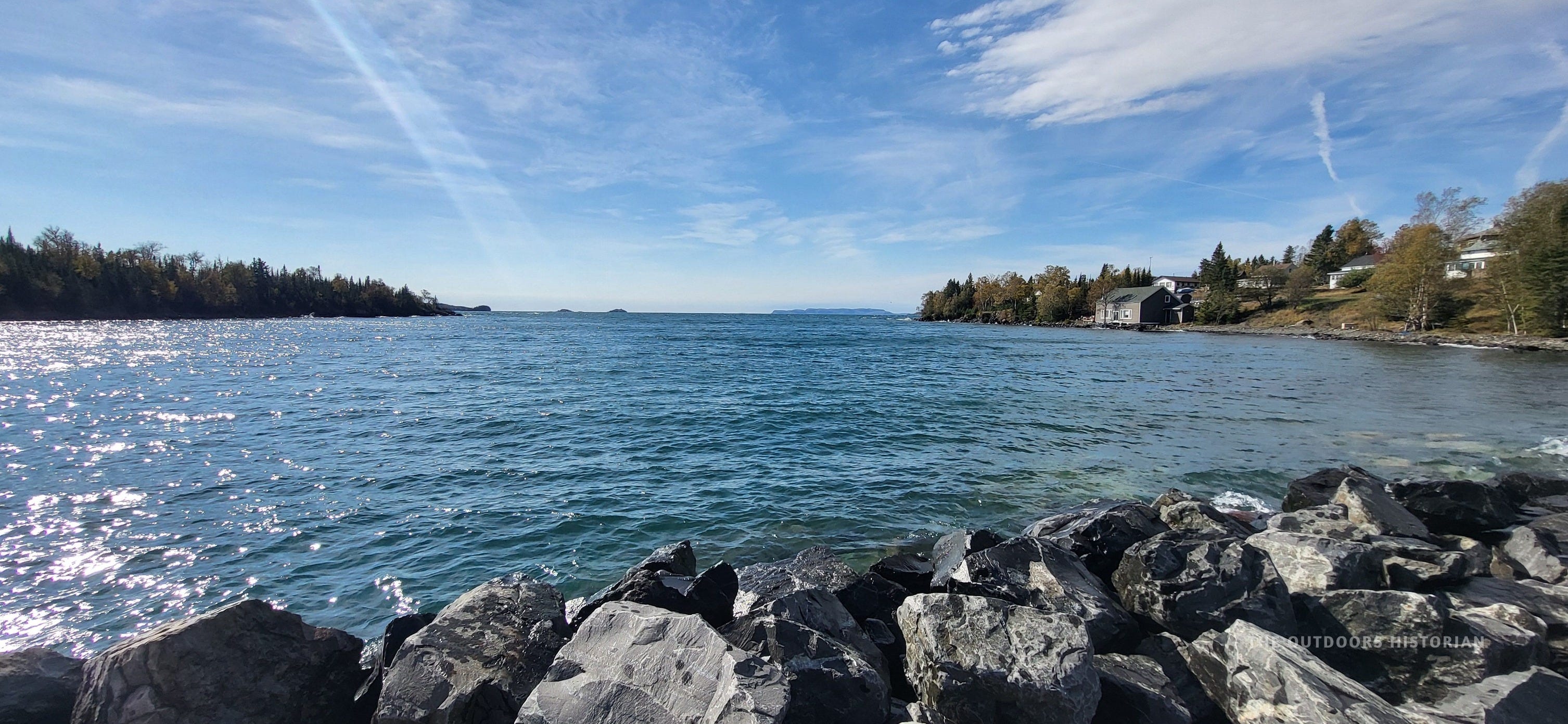
Standing on the docks, the feeling is surprisingly intimate. You are not looking out at an infinite expanse of open water; you are looking directly at the jagged profile of Burnt Island. The view is framed with purpose: to the west, you see the opening to the literal Thunder Bay; to the east, the route leads toward Porphyry Island. It was a moment of our journey I vividly remember: standing on the wood planks, realizing I was at the intersection where the raw materials of this region were funneled out to the world.
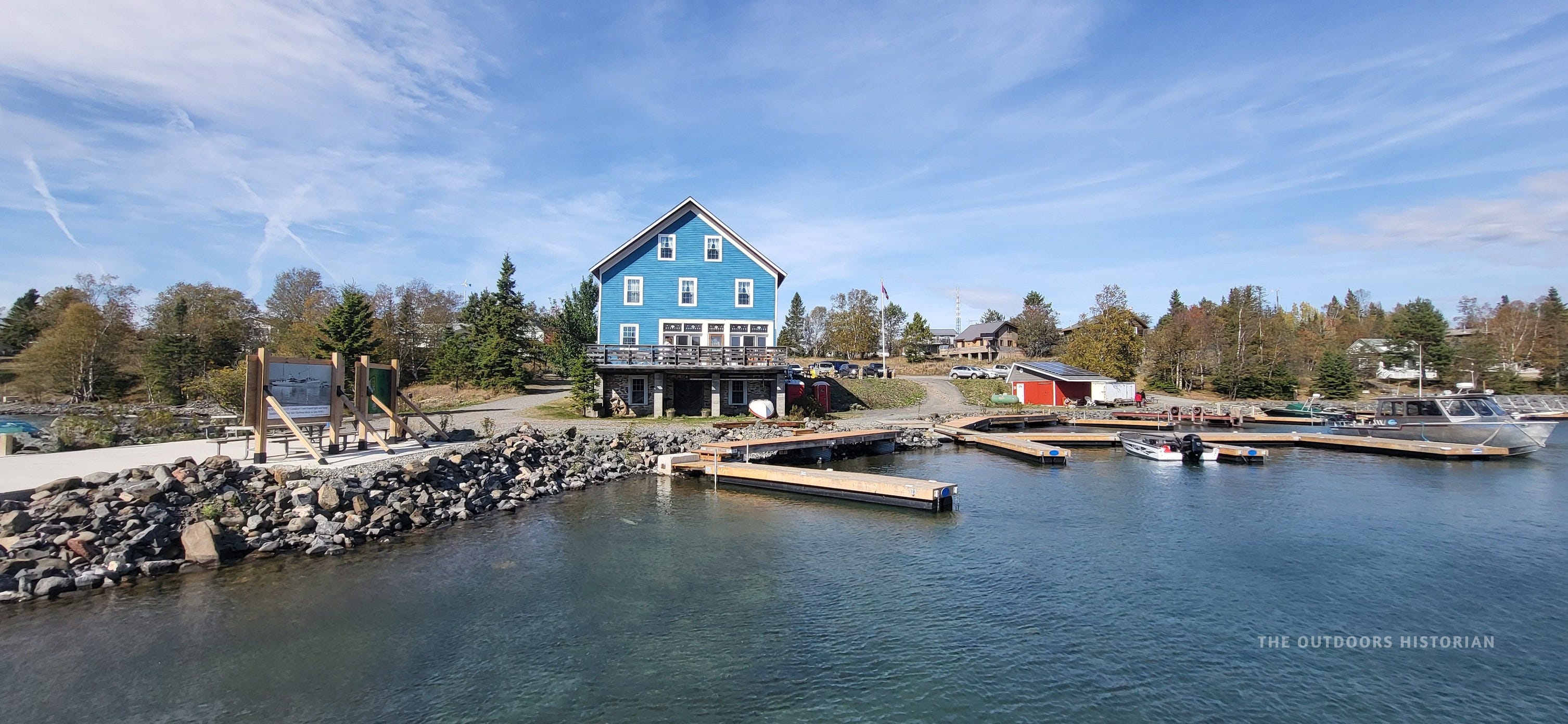
This is where the industrial throughline of our trip truly begins. If the Pee Dee railroad was a failed attempt to extract iron, Silver Islet was the successful-yet-short-lived blueprint for extracting wealth from the lake.
Following the Robinson-Superior Treaty of 1850 when Anishinaabe people ceded the land in the Lake Superior watershed north of the border to British Canada (Canada becomes an independent nation in 1867), the Montreal Mining Company discovered a vein of pure silver in the Sibley Peninsula. For the Anishinaabeg, this was the home of Nanabozho, and the extraction was a violation of a sacred protector. For the newly created nation of Canada, it was the first proof that the western extents of Lake Superior held global wealth.
Between 1870 and 1884, miners fought the lake to extract millions of dollars in silver. They used pumps and built wooden cofferdams to hold back the icy waters of Superior. For a few years, the mine produced immense wealth for its stockholders. But like the Pee Dee railroad, this system was fragile. In 1884, a single missed coal shipment silenced the pumps, and the lake reclaimed the mine instantly. It was the ultimate boom-and-bust experiment.
The irony of 'Refuge vs. Refuse' surfaces here again. Similar to what we saw at Black Beach, where tourists lounge on taconite tailings, the residents of Silver Islet are finding refuge in a community formed around extraction. The layout of the village reinforces the immediacy of the water. The cottages are jammed right against the shoreline: it quickly turns from shore to road to cottage, with almost no buffer. The shore is armored with riprap and gabion cages to protect the structures from high-energy waves.
The people here live on the lip of the Big Lake at the tip of the peninsula. Beyond Burnt Island in the open waters lies the remains and refuse of the mine. Like so much of the history in the Lake Superior watershed, it is defined by resource extraction on Anishinaabe lands and waters.
Ephemeral Memorials: The Historic Cemetery
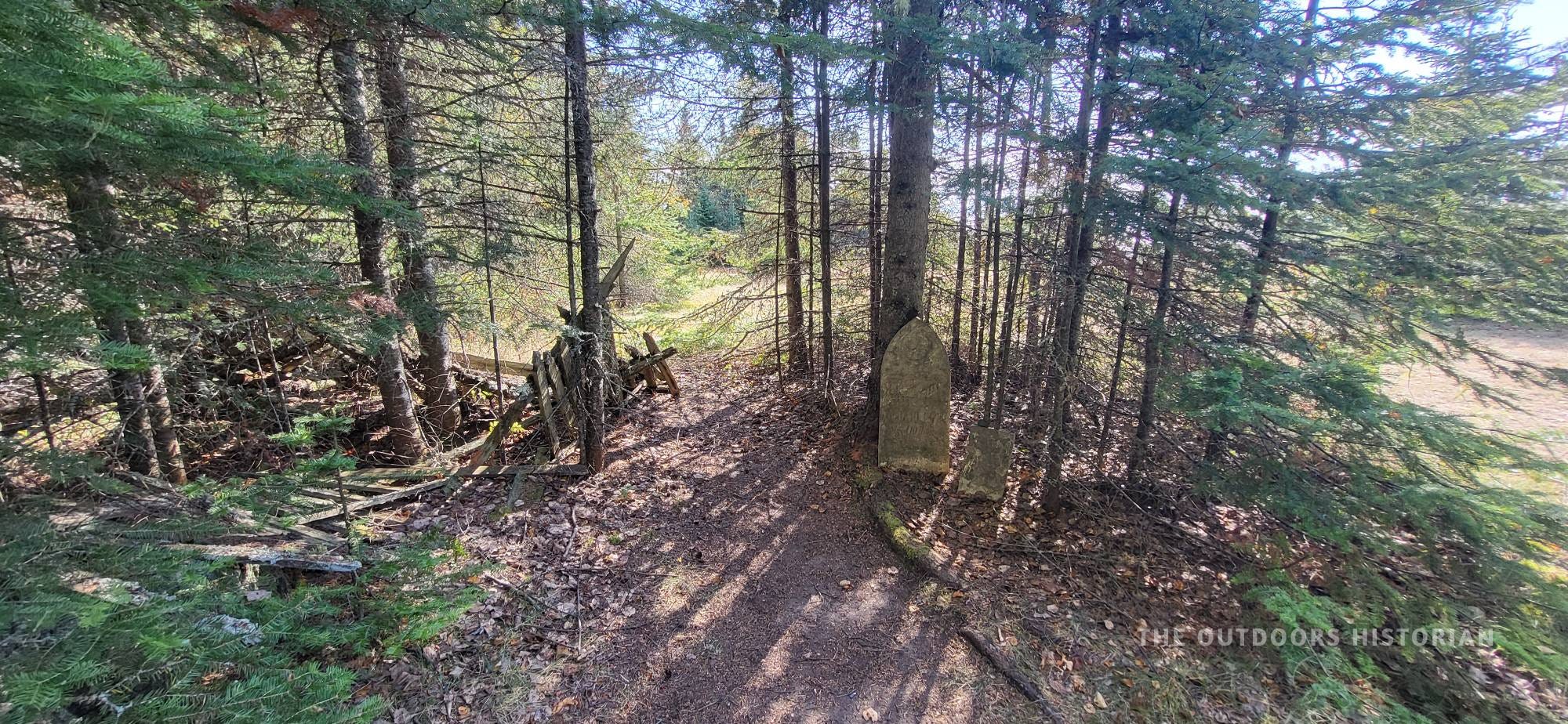
Another human side of this ambition is buried just behind the cottages. After our visit to Silver Islet General Store, Eugene and I hiked the Historic Cemetery Trail (1870–1937), which sits in the woods directly behind one row of summer homes.
It is a stark reminder that Silver Islet was not just a mine; it was the foundation of a village. Miners brought their wives and children to this jagged edge of the continent, trying to build a domestic life in the shadow of industrial danger. Their descendants continued to carve out a life here. The trail through the cemetery was narrow. The boreal forest felt thick, filtering the light even on a sunny day. Mushrooms emerged from rotting nurse logs, a vivid reminder of the intertwined relationship between life and death. The air felt still, and the layers of history felt personal.
Many graves were marked with wood; today, young trees grow directly through picket fences. Their roots are slowly merging with the memorials. The most tragic markers are for infants who lived only a few days. Even the “wealth” of the world’s richest mine could not provide the stability or medical care needed to save a newborn here. Standing on that bluff, looking at the birch trees reclaiming the graves, I felt a deep resonance. Systems rise and fall. Mines flood. Railroads rust. Colleges close. But the boreal forest returns.
The Survivors: Old Growth and Boreal Bogs
While much of the Sibley Peninsula’s history is industrial, its “soul” is found in the things that both predate and survive the extraction. Of course, there’s the Giant. But there’s also so much more.
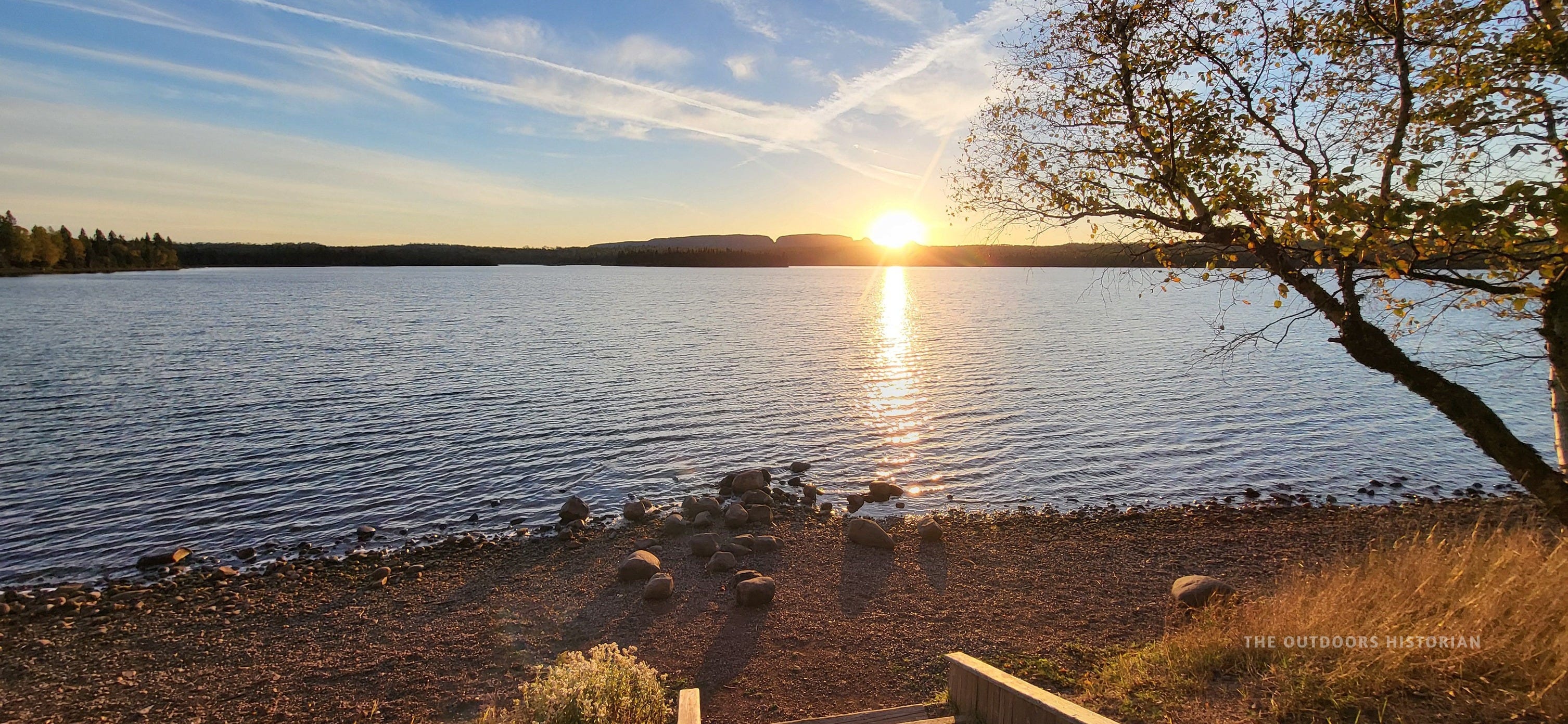
We based our stay at the Marie Louise Lake Campground. Typically, Eugene and I avoid campgrounds with over a hundred sites, preferring the quiet of smaller, rustic locations. But Marie Louise is the only vehicle-accessible campground in the park. This is where the strategy of the shoulder season shines. In July, this place would be a bustling city of tents and RVs. In late fall, we had entire sections to ourselves. It allowed us to find solitude even in a “mega-campground.” And the reward was worth it: from our site, we had a direct, uninterrupted view of the Sleeping Giant.
Exploring different vacant sites in the campground, we stumbled upon a stand of old-growth cedar. Cedar (giizhik in the Anishinaabe language) is a tree of deep significance in the Great Lakes, known for its longevity and its role in Anishinaabe medicine. To find a stand that has escaped the logging saws of the last century felt like discovering a living archive.
To deepen this connection, we returned to the area near the Thunder Bay Lookout to hike the Bog Trail. This time, instead of looking out at the vastness, we looked down. While the cliffs are a place of wind and height, the bog is a place of springy sphagnum moss and acid-loving resilience.
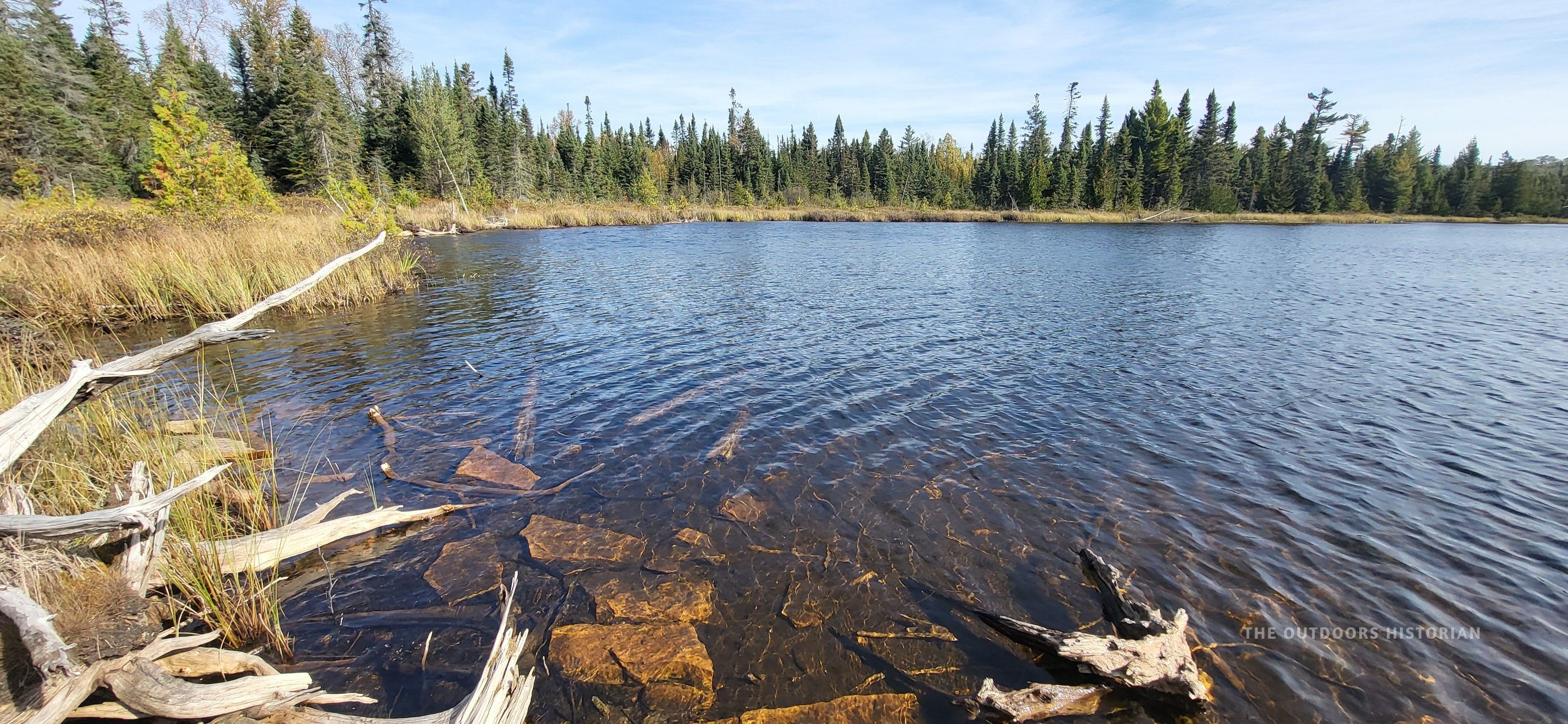
We had the trail to ourselves. Walking over the lichen-covered hard Canadian Shield bedrock and stepping over exposed spruce and cedar roots on the trail, I thought about the woodland caribou that once roamed this peninsula. They were driven out over a century ago by the very settlement and logging we saw evidence of earlier. The lichen they rely on remains, but the ghosts of the herd are gone. Today, there are still small herds of caribou in the watershhed on the Slate Islands and the Michipicoten Island.
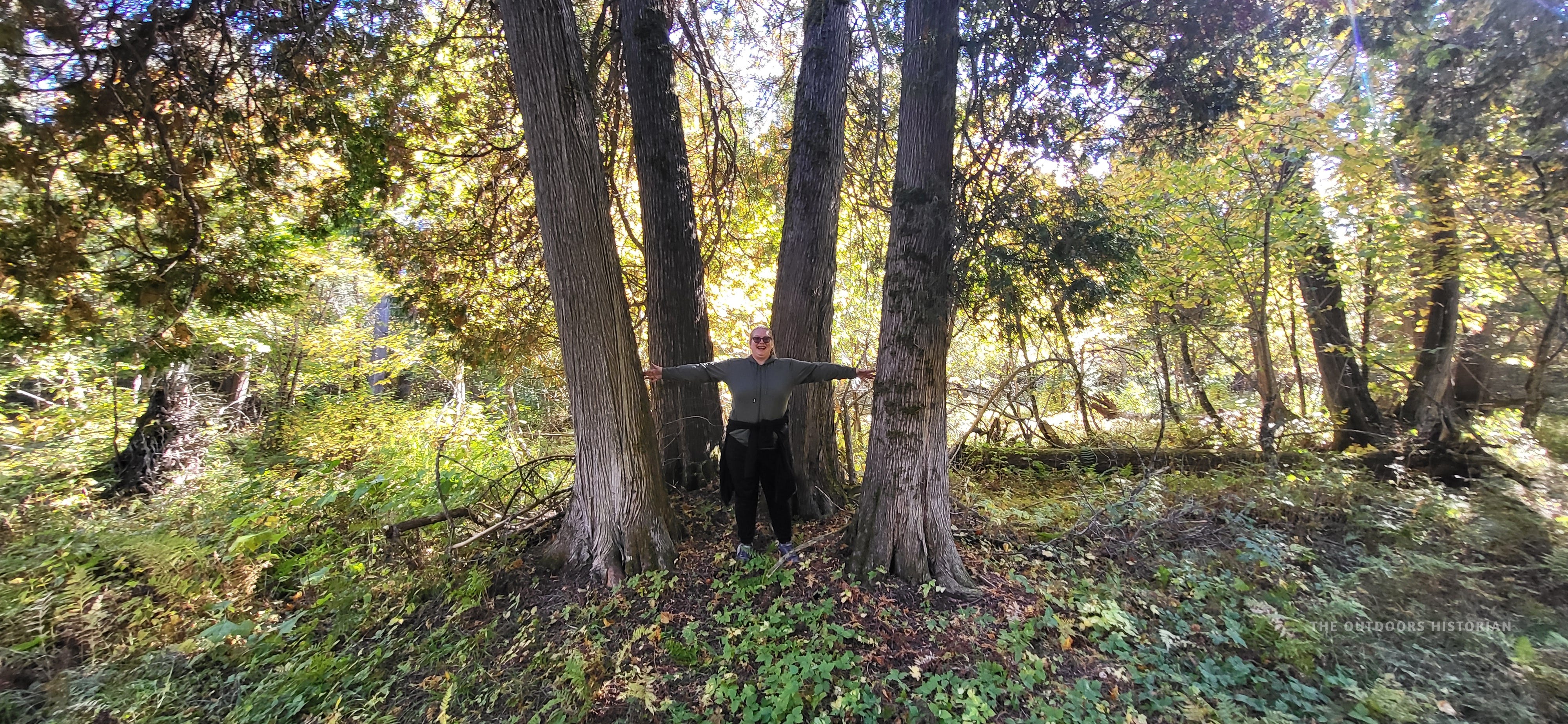
After spending time at the park, I think that these pockets of ancient life—the cedars, the bog, the falcons—join the Giant in being the soul of the peninsula.
The Wind of the Giant
Our time at Sleeping Giant ended with a reminder of Lake Superior’s power. When you camp on a peninsula in the Big Lake, it defines your weather even when you aren’t directly on its shores. A thunderstorm brought gusts over 70 km/h on our final night. We lay awake as the tent fabric of our Clam Tent snapped and wondering how well our tieouts and pegs would hold, listening to the Giant “breathing.” By early dawn the storm subsided, and while the winds stayed high, we drifted back to sleep until morning.
In the morning, we got up and congratulated ourselves on surviving the windiest night we’ve ever spent camping—a night when most campers in soft-sided tents fled. We packed up our site, showered in the park’s “comfort station,” and were ready to move on.
The storm, the bog, and the old-growth cedar were reminders: don’t let the provincial park signs fool you. This is a place where the spirits and non-human beings that have animated this landscape for millennia are still the most powerful and humans ignore them at our peril.
We said goodbye to the Sibley Peninsula and headed east toward Neys where the beauty of the sunset interacts with a dark chapter of Lake Superior history.
In Part 3, we travel to Neys Provincial Park to uncover the ghosts of Jackfish and the paradox of Prisoner’s Cove. We also visit “Ontario’s Grand Canyon” and drive what I think is the most striking section of the Lake Superior Circle Tour.
Planning your own Lake Superior Circle Tour itinerary?
Visiting Sleeping Giant Provincial Park Sibley Peninsula can be one of the most complex logistical parts of the Circle Tour (especially if you want to book a campsite at Marie Louise Lake in July).
Get the Basics: Download my Free Circle Tour Planner .
Get the Strategy: If you want to know which campsites have the best views of the Giant or how to time the Sea Lion hike to avoid the crowds, Book a 1-Hour Strategy Session.
P.S. I’ve been getting some questions about the specific maps and GPS coordinates for these stops. If you want flexible itineraries for your Circle Tour that includes detailed maps for the whole lak, check out my Field Guide!
Have you visited Sleeping Giant Provincial Park? What were your favorite parts Have questions about your to plan your ultimate Circle Tour itinerary? Let me know in the comments!
These are great reads Emily. I've never done the Circle Tour, but would like to in a few years. One of my college buddies and his family did it this Summer (we just missed each other at Gooseberry Falls by a day), and they loved it.
Thanks for sharing your knowledge and I look forward to reading more.
--Rob