
The Treaty of Prairie du Chien was signed two hundred years ago on August 19, 1825, at Prairie du Chien on the Wisconsin River in Wisconsin Territory (Wisconsin became a state in 1848). The treaty was attended by American officials and Indigenous nations west of Lake Michigan (mainly from present-day Wisconsin and eastern Minnesota).
Understanding the Treaty in Context: The Treaty of Prairie du Chien and the Rise of Removal Policies
As I have discussed in my piece on the Treaty of Fond du Lac, at Prairie du Chien, American officials (including Lewis Cass and William Clark) met with over 5,000 Dakota, Menominee, Ho-Chunk, Sauk, Meskwaki, and Ojibwe (also known as Anishinaabe) people to determine the boundaries between Indigenous nations’ lands. This was the first time any boundaries between Indigenous peoples in this region were mapped (and subsequently fixed) on paper. Indigenous nations at the treaty also agreed to peace among them and acknowledged the authority of the United States to intervene to maintain peace.
The Treaty of Fond du Lac and Ojibwe Leadership in the Lake Superior Region

On August 5, 1826, the Treaty of Fond du Lac was signed between Ojibwe peoples in the Lake Superior watershed and the American government. The treaty negotiations occurred at the western end of Lake Superior, in what is now Duluth, Minnesota. The treaty must be understood in the context of the Treaty of Prairie du Chien, signed the previous year. Americ…
The Treaty of Prairie du Chien was not a land cession treaty. Instead, it laid the foundation for future land cession treaties. Before the United States could go to Indigenous nations and “ask” (which usually meant coerce and pressure) them to cede lands, they needed to have Indigenous nations agree on who controlled which lands. That way American officials knew which nations to go for to gain control of specific lands.
To be clear, this was not the case of Indigenous nations agreeing to American ideas of land ownership and control. Instead, it was Indigenous nations acquiescing on paper when they had few options for legal maneuvering. If Indigenous nations refused to work with American officials at treaty negotiations, Americans would escalate to aiming to gain control of lands through force (including forced removals, massacres, and wars). Treaties are complicated. They both recognize Indigenous sovereignty and give this sovereignty meaning in an Anglo-American legal framework, and they are an example of the violent history of the United States' expansion.
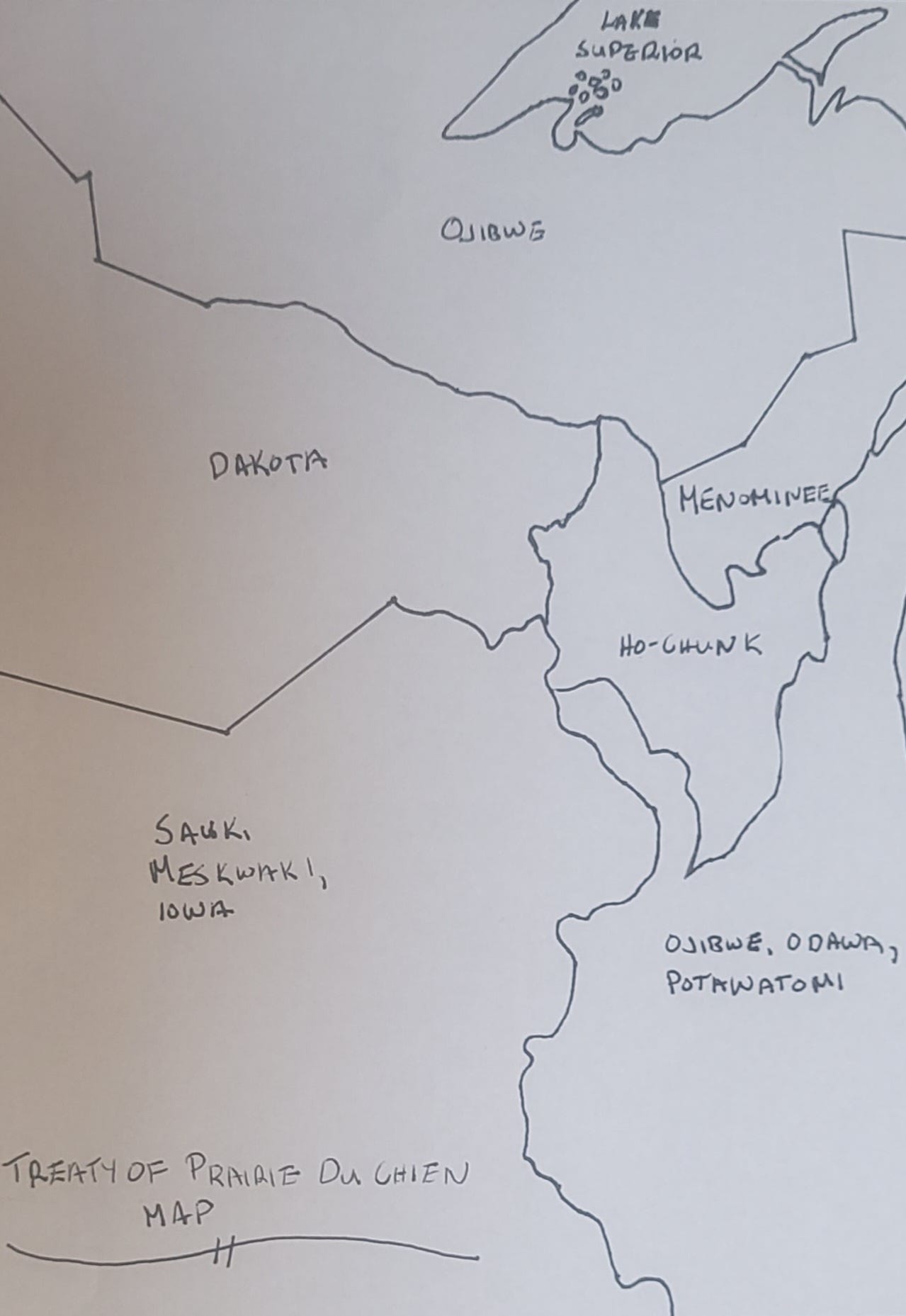
Map of the approximate division of territory that resulted from the Treaty of Prairie du Chien. Map drawn by the author.
The Treaty of Prairie du Chien also needs to be understood within a broader national context. Five years after the Treaty of Prairie du Chien, a newly elected President Jackson ushered in a new era of federal Indian policy characterized by forced removals. Jackson ignored decisions by the United States Supreme Court like Worcester v. Georgia that (problematically) recognized Indigenous sovereignty and Cherokee claims to land in north Georgia, and passed an an executive order, commanding the United States army to remove Indigenous peoples from lands east of the Mississippi River. Known as the Trail of Tears, by the late 1830s, Cherokee, Chickasaws, Creeks, and Seminole peoples in the southeastern United States were forced from their homes and removed to Indian Territory (present-day Oklahoma). Over 10,000 Indigenous peoples died either during the removal process or upon arrival in Indian Territory.
The Trail of Tears is one of the most well-known examples of Jackson's brutal removal policies. Indigenous peoples were also removed from the Midwest, including in Ohio, southern Michigan, Indiana, Illinois, and southern Wisconsin. This larger context of removal on a national scale illustrates the political climate that Indigenous peoples east of the Mississippi River faced. These attitudes would spread in the following decades, leading to more removals and the “Indian Wars” in western states in the mid-1800s.
The Importance of Context: The Treaty of Prairie Du Chien and Material Culture
The treaty is illustrated in a painting by James Otto Lewis. Lewis traveled with Cass and other officials to record some of the events. In many ways, the painting tells us more about American beliefs about the treaty and Indigenous peoples than it does about the actual proceedings.
Many elements of Lewis’ painting emphasize American authority: the U.S. flags, American officials at the podium toward the center of the painting, American soldiers in uniform and with prominently displayed firearms throughout the painting, and what appear to be church steeples rising above the scene. American officials and soldiers appear orderly and in straight lines and rows, whereas Indigenous peoples are scattered throughout the painting in informal groups, with one larger group crowded around the podium. This American authority was largely in American imaginations. In 1825, Indigenous nations like the Ojibwe, the Dakota, and the Menominee were the political powerhouses of the region.
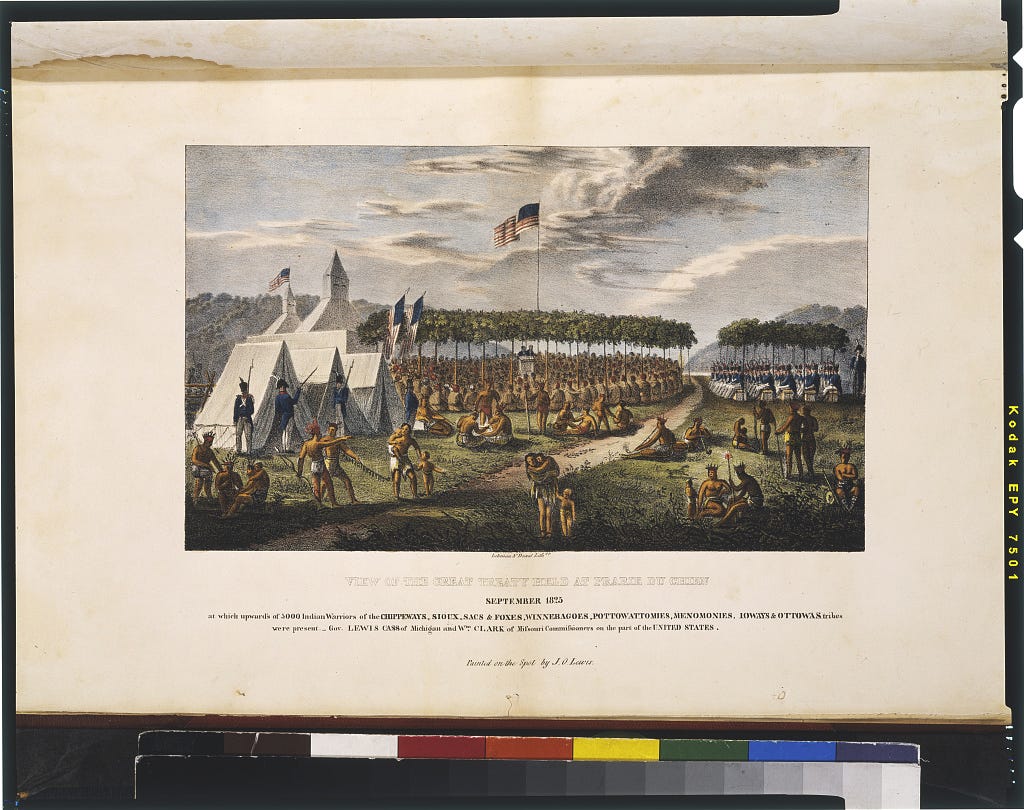
View of the great treaty held at Prarie [sic] du Chien, September 1825 [graphic] / painted on the spot by James Otto Lewis, published in Many nations: A Library of Congress resource guide for the study of Indian and Alaska native peoples of the United States, edited by Patrick Frazier and the Publishing Office. Washington : Library of Congress, 1996, p. 123. Available online.

Lewis portrays Indigenous peoples as sitting in the grass or on stumps. Interestingly, while there are numerous different Indigenous nations who attend (with their own language, political customs, spiritual beliefs, and cultural values), in the painting, Indigenous peoples are portrayed as the same. In other words, their sovereignty and political diversity are erased to emphasize their “sameness.” Even though Ojibwe and Dakota people (and other Indigenous nations who attended) are engaged in very real political conflicts (not only in the build-up to the treaty but also in the years following the treaty, despite the promises of peace embedded in the treaty), Lewis blurs the differences between them, showing them as a homogenous and racialized group. Whether or not it is intentional, his painting erases their political differences and, subsequently, their sovereignty. In the painting they are shown as “Indians”—not as sovereign Indigenous nations. A lot of white people in the present do not understand Indigenous sovereignty. Learning about treaties is one way to educate about sovereignty and shared histories of settlers and Indigenous people.
To be clear, none of this is to say Lewis is a bad person or that his painting is bad. Some accounts emphasize he did his best to portray what he saw accurately and that he was empathetic to the challenges Indigenous peoples faced in the early decades of the nineteenth century. But well-meaning people can still have biases. And as historians, it's our job to analyze what people's actions (including the creation of art) show about their respective beliefs, and we put that in context within the time period to better understand the interaction between politics, culture, and individual lives. This can help us better understand aspects of our own lives. It is not about making moral judgments about individuals or judging them against our current moral standards of the present day. In the past and present, people are complex. One dimensional depictions are rarely accurate.
Material culture gives us insights into the past. But sometimes, in terms of visual and print material culture, it shows us more about the beliefs of its creator than it does about the events or people it is portraying. Being able to tease this out and understand when it is happening is part of the work of interpreting sources. It’s also why historians always analyze multiple sources and look at them in conversation with each other. Isolating a single source and looking at it outside of the larger context can lead to a skewed understanding of history that further perpetuates biases and stereotypes. This is also why I think that primary sources always need to be taught in context. I know there are some philosophies of education that emphasize reading primary sources. And reading primary sources is an important part of teaching history. But these sources need to be taught in context. Otherwise, even teaching with primary sources can lead to a perpetuation of our own biases (this topic probably deserves a Substack of its own, so I'll probably return to it at some point).
The Impacts and Significance of the Treaty of Prairie du Chien
The treaty's impacts were not immediately felt in the lives of Ojibwe people. However, by the early 1850s, Ojibwe people's lives in Wisconsin had significantly changed. The Treaty of Prairie du Chien laid the foundation for land cession treaties, like the Treaty of St. Peter's in 1837 ("The Pine Treaty") and The Treaty of La Pointe in 1842 ("The Copper Treaty"). These treaties led to the growth of new industries, like logging and mining, and these industries led to political and demographic changes (American settlers becoming the majority and solidifying their political power, including legal systems) and significantly impacted the environment.
The Pine Treaty: A Turning Point in Wisconsin History

Many Wisconsinites associate the Northwoods with inland lakes lined by white pine. But before the white pine was associated with the iconic beauty of the Northwoods, it shaped many aspects of the state's history.This Substack is reader-supported. To receive new posts and support my work, consider becoming a free or paid subscriber.
Yet the Treaty of Prairie du Chien's long-term impacts were substantial. Along with being the foundation for land cession treaties and demographic shifts, the Treaty of Prairie du Chien affects other aspects of how Ojibwe nations exercise their sovereignty in the present. Agreeing to the boundaries between their neighboring nations later defined which territories Indigenous nations, like the Ojibwe in northwestern Wisconsin, would have legally defined treaty rights to hunt, fish, and gather. For example, if Ojibwe leaders had argued that their territory extended further south, and if American officials agreed to this, then in the present-day, the area where Ojibwe people could exercise their treaty rights would extend further south.
While treaty rights, also known as usufructuary rights, were embedded in the land cession treaties that followed the Treaty of Prairie du Chien, state game wardens and municipal law enforcement criminalized Ojibwe people for practicing them. Ojibwe people were arrested, and in some cases, beaten and murdered (like Gishkitawag, also known as Joe White) for hunting, fishing, or trapping without a the required state licenses.
In the late twentieth-century, Ojibwe people challenged the criminalization of treaty rights that they and their ancestors experienced. After many lengthy court battles, the United States legal system affirmed the ongoing legitimacy of treaty rights on ceded territory in Michigan, Wisconsin, and Minnesota. Exercising treaty rights is a significant way that Ojibwe people continue to exercise their sovereignty.
The Treaty of Prairie du Chien shows how events from two centuries ago continue to have an impact on legal systems in the present-day.
Suggestions To Learn More
If you’d like to learn more about how Ojibwe leaders negotiated at the Treaty of Prairie du Chien and The Treaty of Fond du Lac, or if you’d like to learn more about the criminalization of treaty rights in the late 1800s, I highly recommend Erik Redix's, The Murder of Joe White: Ojibwe Leadership and Colonialism in Wisconsin, (Michigan State University Press, 2014).
If you’d like to learn more about the legal battles in the twentieth century to have Ojibwe treaty rights, I suggest the Ogichidaa Storytellers Series by the Great Lakes Indian Fish and Wildlife Commission.
Have questions? Let me know below!