
Material Culture Monday is something I started posting on other social media, and I want to share on here too! On Monday, I share thoughts about history and material culture!
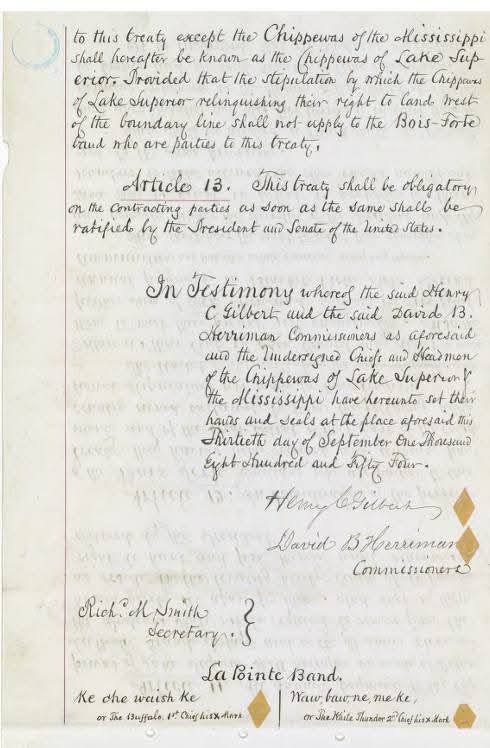
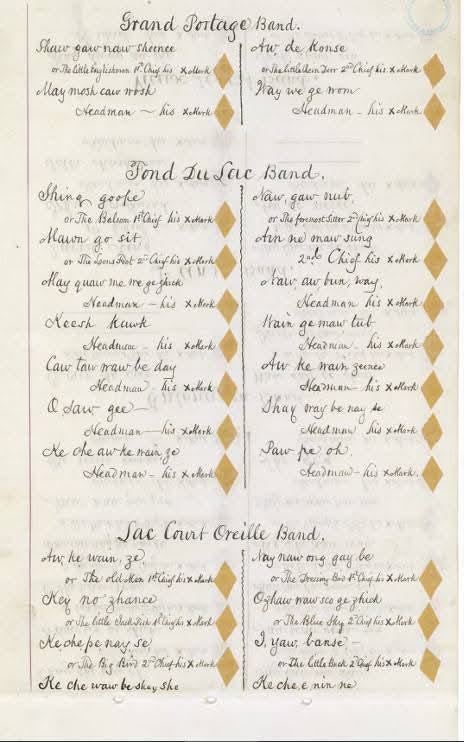
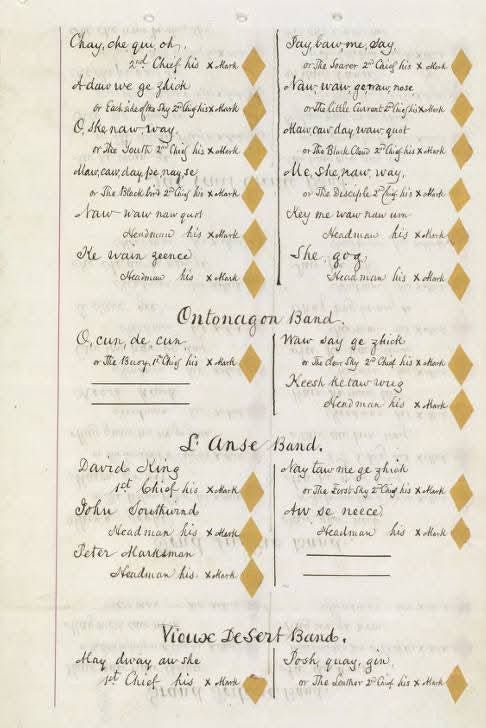
For today’s Material Culture Monday, I'm talking about the Treaty of La Pointe in 1854!
On September 30, the Treaty of La Pointe in 1854 was signed between Anishinaabe nations in the western Lake Superior region and the United States federal government.
This treaty has important and long-lasting implications for Wisconsin, Minnesota, and Michigan.
The treaty ceded the Minnesota North Shore to the United States and created the majority of Anishinaabe reservations in northern Wisconsin and the western Upper Peninsula of Michigan.
Like many parts of history, this treaty has multiple sides. On the one hand, it secured permanent homelands in the western Lake Superior region for Anishinaabe peoples on the American side of the border. On the other hand, it also marks a tipping point in the region’s history: from European arrival to the mid-nineteenth century, Anishinaabe peoples were the demographic majority in the western Lake Superior watershed. From the mid-nineteenth century on, European-descended American settlers became the demographic majority.
This treaty was negotiated in the wake of the Sandy Lake Tragedy. In 1850, President Zachary Taylor issued an order to remove Anishinaabe peoples from the western Lake Superior region, even though the land cession treaties previously signed did not contain removal clauses. Then, Minnesota Territorial Governor Alexander Ramsay changed the location of annuities payments in the fall from La Pointe, on Madeline Island, to Sandy Lake, in Minnesota Territory. Annuities were annual payments of cash and goods and were part of the ways that the federal government compensated Indigenous peoples for land cessions.
When Anishinaabe people arrived at Sandy Lake, payments were delayed for months. This delay was a tactic—Ramsay hoped if the payments were distributed late enough in the year, snow and frozen waterways would force the Anishinaabe to stay at Sandy Lake through the winter rather than return to their homes. The food that eventually arrived was mainly spoiled. Sickness and death spread across Sandy Lake. Yet Anishinaabe people made the difficult trek home, during the cold winter, sometimes having to carry family members who died since the ground was too frozen for burials.
In 1852, a group of Anishinaabe leaders, including Bizhiki from La Pointe who was in his nineties, traveled from Lake Superior to Washington D.C. by a combination of canoe, steamboat, and railroad to petition against the removal efforts. President Millard Fillmore agreed to rescind the removal order and pledged that future annuities would distributed at La Pointe.
The Treaty of La Pointe in 1854 built on President Fillmore’s promises by creating reservations for the Anishinaabe in western Lake Superior. However, Americans did not enter into the Treaty of La Pointe for selfless reasons—they were eager to gain legal access to the valuable iron deposits along the Minnesota North Shore.
A film by the Great Lakes Indian Fish and Wildlife Commission describes the treaty as follows:
“In this treaty they also reserved the usufructuary rights to hunt, fish, and gather on the lands they ceded to the government. They would never be ordered to cede their homelands again. This was a major victory for the Ojibwe that the would impact their people for generations in to the future.”
Anishinaabe historian Erik Redix (Lac Courte Oreilles) emphasizes how this treaty (along with the Treaty of St. Peter’s in 1837 and the first Treaty of La Pointe in 1842) were the building blocks of American extraction from the region:
“The acquisition of the territory of the Lake Superior Ojibwe was tantamount to robbery. Abundant historical evidence demonstrates that Ojibwe leaders were told they were merely selling resources (pine, copper, iron ore) and not the land itself. Moreover, the compensation provided was a pittance compared to the wealth of the resources exploited by the US government in the nineteenth century alone.” (Redix, The Murder of Joe White, 59)
When teaching other settlers who live in northwestern Wisconsin about this treaty, I emphasize that both perspectives are important. The treaty was both a victory for the Anishinaabe people and part of the overall robbery of resources and land that they experienced during the growth of the United States. Both sides of the story are important to understanding the treaty's significance.
The Treaty of La Pointe in 1854 continues to shape the western Lake Superior region today. The treaty is why those of us who live in northern Wisconsin have Anishinaabe nations as neighbors. These nations are important economic drivers in the region (tribal nations are consistently among the top employers in the counties where they are located) and environmental stewards, passing legislation to protect waterways and clean air that benefit everyone who lives in the region.
The treaty is an interesting example of material culture, including the signatures of Ojibwe leaders from different nations. If you want to learn more about the treaty, I highly recommend visiting the exhibit “Passages” at the Madeline Island Museum in La Pointe, Wisconsin! The exhibit includes a drawing of the Oshcabawis Pictograph, an amazing example of material culture that Ojibwe people created during the treaty era.
If you want to learn more about the Sandy Lake Tragedy and the Treaty of La Pointe in 1854, I'll try and list resources in the comments, including a transcript of the treaty and the GLIFWC documentary I quoted.
References
Images and transcript of the treaty:
https://cms9files.revize.com/redcliffband/Document%20Center/Division/THPO/1854%20Treaty%20Original%20Scan%20and%20Typed%20Text%20resized.pdf
Great Lakes Indian Fish and Wildlife Commission, The Sandy Lake Tragedy, available on YouTube: https://www.youtube.com/watch?v=u6VaiLfy3CE
Great Lakes Indian Fish and Wildlife Commission, They Are Remembered: Sandy Lake, available on YouTube: https://www.youtube.com/watch?v=JLig6Pv1b7Y
Erik Redix, The Murder of Joe White: Ojibwe Leadership and Colonialism in Wisconsin, (Lansing: Michigan State University Press, 2014).
Patty Loew, Indian Nations of Wisconsin: Histories of Endurance and Renewal, 2nd Edition, (Madison: Wisconsin Historical Society Press, 2013).
More on the Oshcabawis Pictograph: https://madelineislandmuseum.wisconsinhistory.org/explore/passages-exhibit/#:~:text=The%20Oshcabawis%20Pictograph&text=The%20original%20image%2C%20created%20on,of%20the%201842%20LaPointe%20treaty
And
https://www.wisconsinhistory.org/Records/Image/IM1871
Both perspectives are definitely valuable and it’s so important to remember this with the deconstruction. Thanks so much!