
*In May 2024, I lost my job as an associate professor at Northland College as the institution went through financial exigency. From The Outside Looking In is a series about my reflections about leaving academia.
The US continues to be in an a seemingly increasing constitutional crisis, and there appears to be no end in sight. It seems like it's only going to get worse.
During that, I had two really wonderful experiences in the last week. I decided to pull some of my rough notes into an actual post.
On Wednesday, I joined Dr. Karen Marrero's Native American History classes with undergraduate and graduate students at Wayne State University. Dr. Marrero is a wonderful educator, writer, researcher, historian, and person. I shared one of my academic articles about Ozhaawashkodwekwe's (Anishinaabe) sugar bush and work at treaties (if you’d like a PDF and don’t have access, let me know and I'm happy to share), and my piece on Sugar Loaf Cove for OnLakeSuperior.com.
We had great conversations.
We talked about archives and how to search for women, LGBTQ+ people, and others who sometimes appear hidden in written archives. We also discussed how to think about archival sources more broadly and in context with each other to tell a richer story.
We talked about being a writer and tone and how to adjust it for academic articles vs. public history. We also talked about how public history is a varied space, so my tone may vary greatly between a museum exhibit, a SubStack post, and a webpage focused on tourism.
This led to a conversation about how different tones can serve different purposes. I shared my own experiences that sometimes my 10-minute "TED Talk" style mini-lecture on Native sovereignty will have minimal impact on a friend/family member/colleague/community member/student I'm trying to educate. But maybe that same person has an interest in natural history or forestry. Through that angle, they become interested in Indigenous history and Traditional Ecological Knowledge which creates an opening for me to also educate about sovereignty and treaties.
I shared that my own perspective, as a settler working in Indigenous histories, is that it's my responsibility to "bring in" as many other settlers as possible to a conversation about Indigenous sovereignty. That is part of my responsibility. That work should not fall on the backs of Indigenous peoples. My work is also to direct the people I'm educating to Indigenous voices who can further educate them about what they are interested in or speak to their interests. For example, I have family members who love to read fiction, and gifting them great novels by Indigenous peoples is one way I can help connect them to Indigenous voices.
We talked about the political work of Indigenous women throughout the Great Lakes, putting Ozhaawashkodwekwe's life in conversation with other Indigenous women.
We talked about intersections between Indigenous and Black histories and their relationship to gender throughout the history of the United States and in different regions, noting that while several main threads connect these histories nationally (including the need for Indigenous land and dispossession of Indigenous peoples from the land and the need for the labor of enslaved peoples), the way these power dynamics played out on the ground varied a lot depending on the region and the specific period we are looking at (there are turning point events that affect these dynamics, including the American Revolutionary War, the abolish of the transatlantic slave trade, the Indian Removal Act, etc.), and the region we are looking.
The relationship between Blackness and Indigenousity was not the same in the 1830s in the Midwest and the Southeast. However, there were also differences and complexities within these regions; Detroit and the South Shore of Lake Superior were also very different at this time.
It was a fabulous experience that I really and truly enjoyed! To my friends in academia, I'd love to join your classes sometime. Even though I'm not officially in academia anymore, please feel free to reach out if you think I'd be a fit for the classes you are teaching!
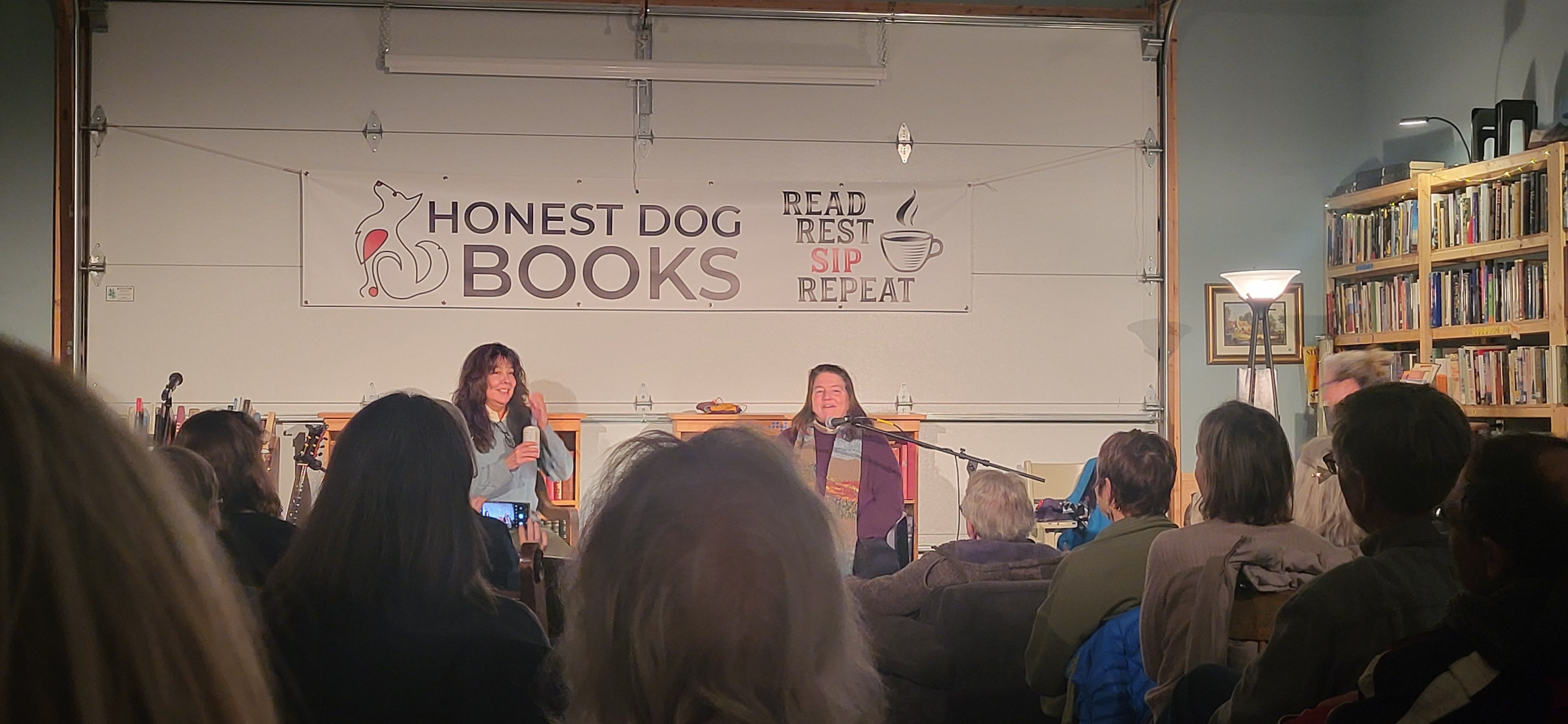
Now, onto the second event. This past Saturday, I had the pleasure of hearing Pam Houston and Deborah Jackson Taffa talk in Bayfield, Wisconsin. Spending the evening with them was truly a gift. Thank you so much to Honest Dog Books for organizing and hosting this event!
This event wasn't on my radar until a close friend mentioned it. Not only did he say he got tickets, but he also started Deborah Jackson Taffa's Whiskey Tender and said it was really good. I wasn't familiar with either author. But I really trust this friend's opinion of literature a lot. So, I figured it would be worth getting my own ticket, especially since the event was close to me. And I'm so grateful I did!
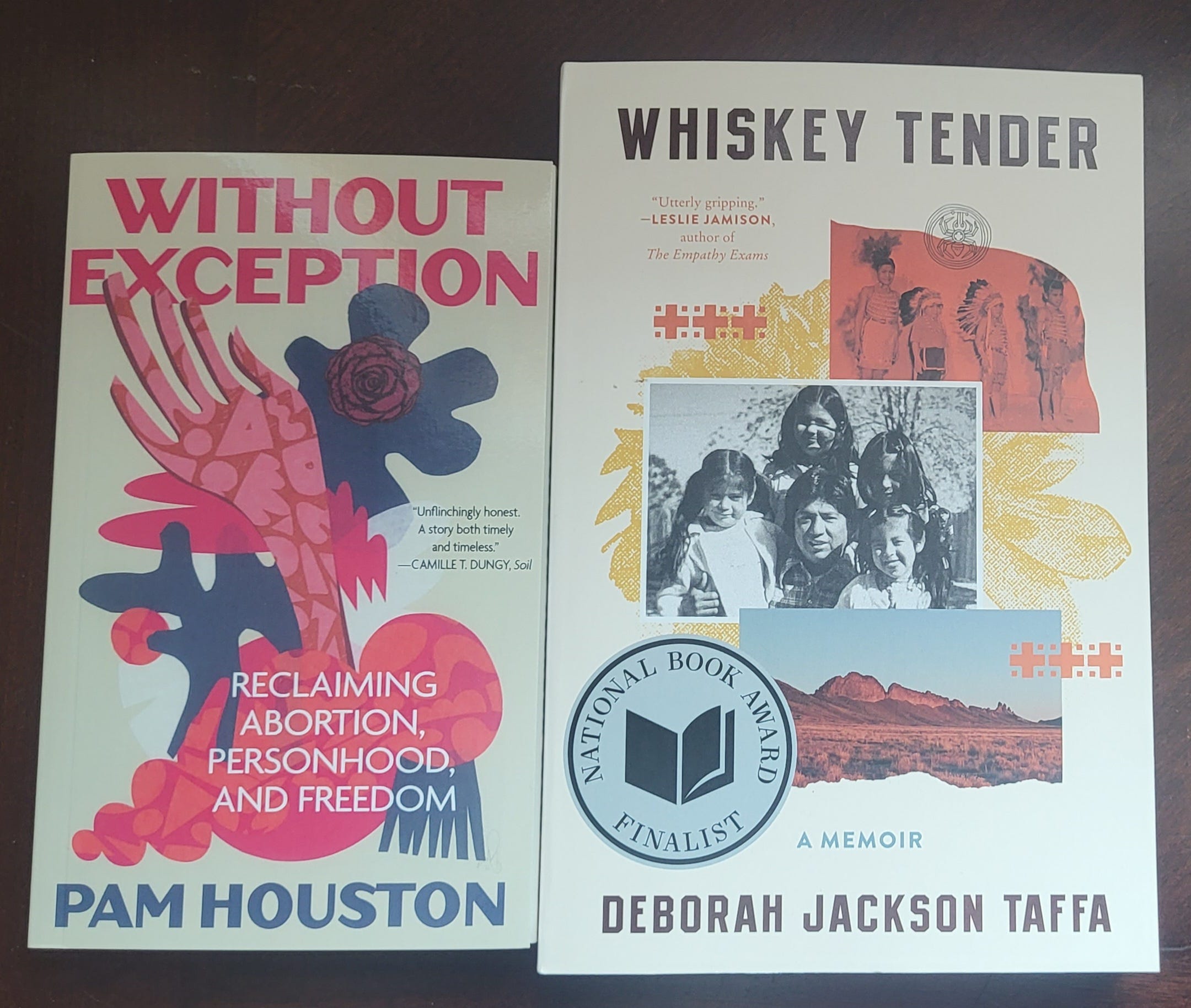
Along with the Whiskey Tender copy included with my ticket to the event, I bought two copies of Pam Houston's Without Exception: Reclaiming Abortion, Personhood, and Freedom.
I forgot to bring a notebook, and I thought I'd just listen and absorb, but I quickly realized I needed to write some things down. So, I took notes on my phone. These are all me paraphrasing them, and any errors are my own! Also, I was trying to keep track of who said what on my phone, but during some conversations, it was hard for me to keep track of things.
There was so much more than just this. Truly, these are just the surface of the amazing insights shared.
*Gems about life and writing from Pam Houston*
Positive experiences still exist among us in these very frightening times.
The real stories are always multiple.
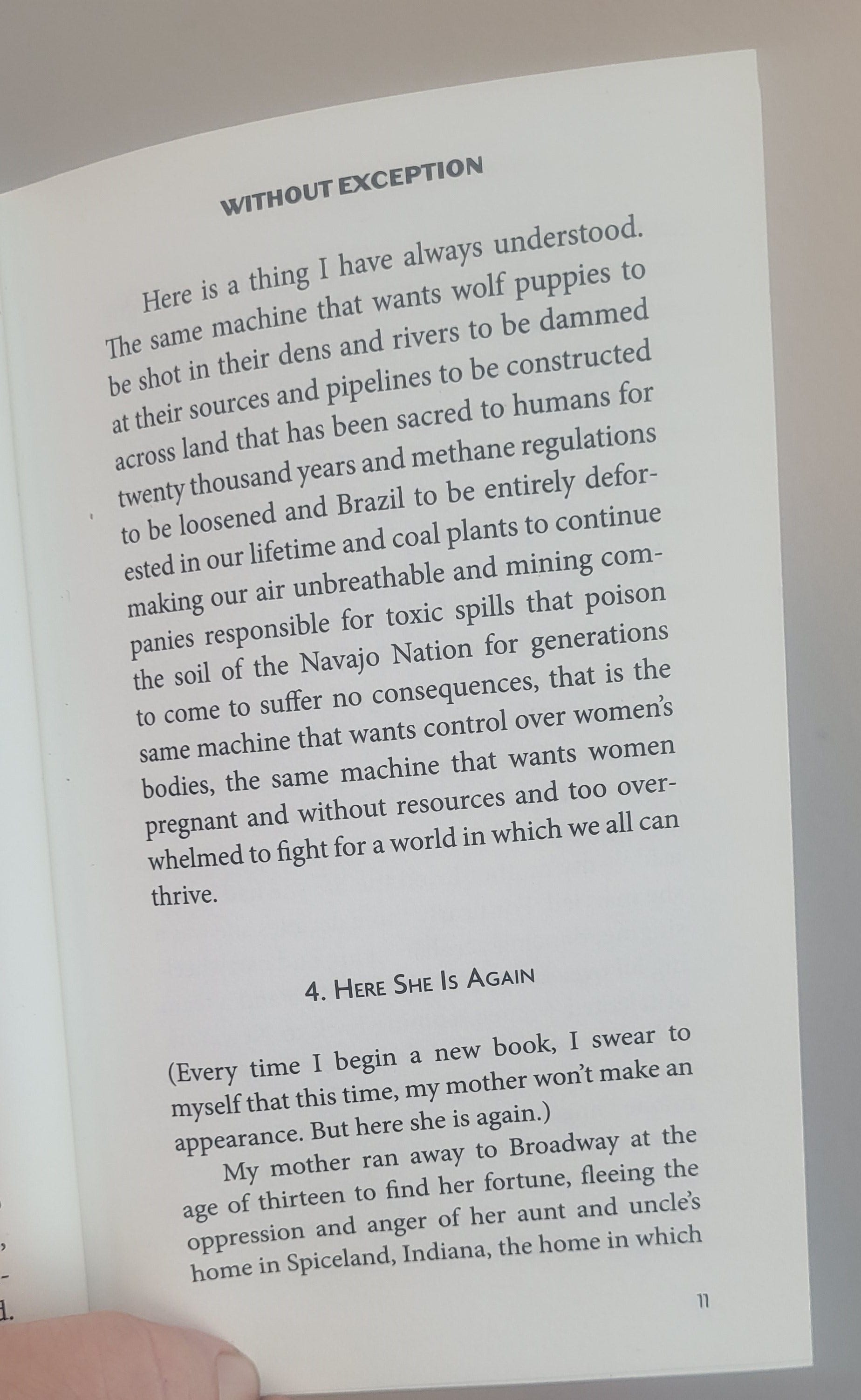
Throughout her reading and talk, she emphasized the importance of how loving and caring for a place connects to freedom and autonomy over women's bodies. Here is a quote from one of the chapters she read from Without Exception (pg. 11):
"Here is the thing I have always understood. The same machine that wants wolf puppies to be shot in their dens and rives to be dammed at their sources and pipelines to be constructed across land that has been sacred to humans for twenty thousand years and methane regulations to be loosened and Brazil to be entirely deforested in our lifetime and coal plants to continue making our air unbreathable and mining companies responsible for toxic spills that poison the soil of the Navajo Nation for generations to suffer no consequences, that is the same machine that wants control over women's bodies, the same machine that wants women pregnant and without resources and too overwhelmed to fight for a world in which we all can thrive."
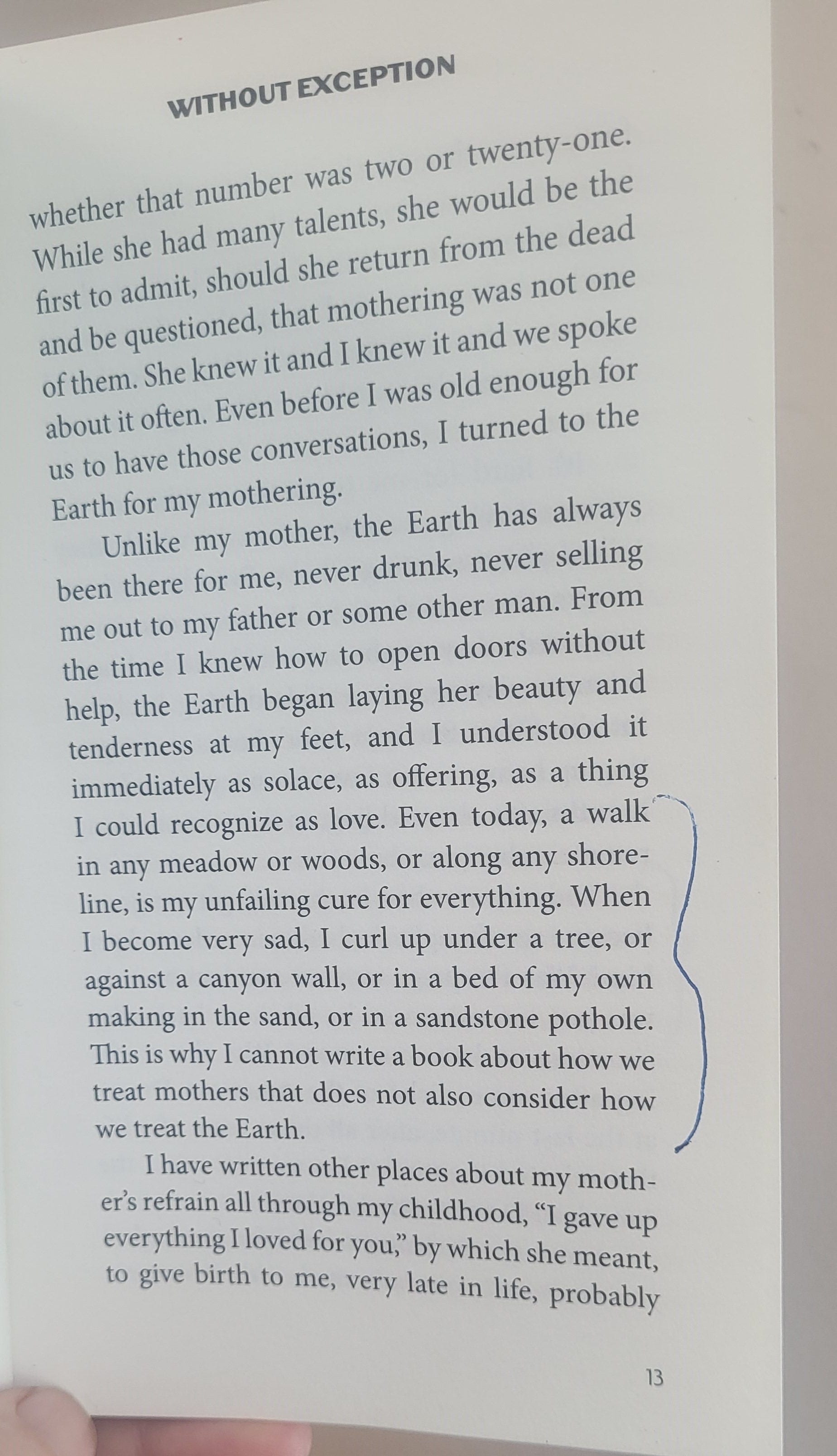
Here is another quote I've read (since the reading) that I love. It is from pg. 13:
"Even today, a walk in any meadow or woods, or along any shoreline, is my unfailing cure for everything. When I become very sad, I curl up under a tree, or against a canyon wall, or in bed of my own making in the sand, or in a sandstone pothole. This is why I cannot write a book about how we treat mothers that does not also consider how we treat the Earth."
Your silence will not save you if you are a woman, no matter how much privilege you have.
(This is in response to a question about how you approach writing: do you outline, do you just start writing, do you work on character development etc.) Glimmers: Non-negotiable moments in life that catch your attention and you observe as carefully as possible. Then, when you have time, do a "glimmer dump": write down the ideas, then return to them and write- 8 -10 one-page write-ups or so of the glimmers, then spread those around you and begin to think about how they're related.
*Gems about life and writing from Deborah Jackson Taffa*
Damage is done to your children when a nation doesn't reconcile with its violent history.
We'll get through it as long as we have a local community and are connected to others who share our values.
When it comes to Indigenous histories, in many cases, it seems like we only learn about genocide. Why do we not learn about architectural masterpieces or the amazing botanical inventions of our ancestors?
Memoirs show that Indigenous peoples' experiences matter.
Hidden histories and governmental policies shape Indigenous peoples' lives.
We can be both things (contradictions), and we're still entitled to our sovereignty.
Women make the world, and we can make micro countries of love.
Getting good at flash fiction (750 to 1000 words) is a good way to build your writing skills and get used to developing a story.
Writing is art and art is arrangement, art is display, art is cutting.
Writing is divination because you write what you want to see.
If you aren't afraid, you are doing something wrong.
I know my book won't be for everyone. And that's okay.
All we have is care for ourselves and care for each other. And that is a lot.
Writing is a matter of craft, and you should try hard to make every sentence sing.
(When writing about family and friends) Assume responsibility for your role in things, and have grace and empathy for others.
Take your time, get it right, and honor the work.
I hope sharing my experiences brings you some glimmers of connection and community during a dark time. If we keep sharing glimmers, they can ripple out and create a stronger source of light.
I forgot to put this little intro at the beginning:
"*In May 2024, I lost my job as an associate professor at Northland College as the institution went through financial exigency. From The Outside Looking In will be a series about my reflections about leaving academia.*"